The PPWR is Regulation (EU) 2025/40 on packaging and packaging waste. It has applied across the EU since 12 August 2026 and replaces Directive 94/62/EC. It requires recyclable packaging from 2030, minimum recycled content in plastic and less empty space: film, format and case on the packaging line all need reviewing.
The PPWR regulation has been explained at length from the legal side. Here we explain it from the machine: what the PPWR asks of packaging and what you will need to adjust on your packaging machine, case packer and palletiser to comply. It is written by YM Packaging Group, a Spanish manufacturer of packaging machinery and turnkey lines.
What is the PPWR (Regulation (EU) 2025/40)
The PPWR (Packaging and Packaging Waste Regulation) is Regulation (EU) 2025/40 of the European Parliament and of the Council of 19 December 2024 on packaging and packaging waste. It was published in the Official Journal of the EU on 22 January 2025, entered into force on 11 February 2025 and has applied generally since 12 August 2026 (MITECO, clarification note of 19/05/2026, in Spanish).
The big difference from the previous rules is that it is a regulation, not a directive: it applies directly in every Member State, with no national transposition, and repeals Directive 94/62/EC. The European Commission's goal is for all packaging on the EU market to be recyclable in an economically viable way by 2030 (European Commission, packaging waste).
It covers all packaging, food and non-food: sales, grouped and transport packaging, that is primary, secondary and tertiary packaging. The Commission has also published non-binding guidance, C/2026/3084, in the Official Journal of 10 June 2026.
The UK is outside the EU, but the PPWR applies to all packaging placed on the EU market, including packaged goods exported from the UK.
What the PPWR changes for packaging
The PPWR sets design requirements for all packaging: restricted substances, recyclability, recycled content, minimum weight and volume, empty space, labelling and re-use. These are the ones that matter most for food packaging machines.
Restricted substances (PFAS)
Since 12 August 2026, food-contact packaging containing PFAS above the limits set in the regulation cannot be placed on the market (art. 5). It is the first obligation already in force (MITECO, sustainability and labelling requirements, in Spanish).
Recyclability (grades A, B and C)
From January 2030 only packaging with recyclability grade A, B or C can be placed on the market. From 2035 it must also be "recycled at scale", and from January 2038 only grades A and B will be allowed (art. 6, MITECO).
Recycled content in plastic packaging
The plastic part of packaging will need a minimum share of post-consumer recycled plastic (art. 7):
| Type of plastic packaging | Minimum from 1 Jan 2030 | Minimum from 1 Jan 2040 |
|---|---|---|
| Contact-sensitive packaging made of PET | 30 % | 50 % |
| Contact-sensitive packaging made of other plastics (not PET) | 10 % | 25 % |
| Single-use plastic beverage bottles | 30 % | 65 % |
| Other plastic packaging | 35 % | 65 % |
Source: MITECO, sustainability and labelling requirements for packaging (PPWR). Exclusions include compostable packaging and packaging whose plastic part is less than 5 % of its total weight.
Minimisation and empty space
From 1 January 2030 packaging must be designed with the minimum weight and volume needed for its function (art. 10). Grouped, transport and e-commerce packaging can have at most 50 % empty space from that date, and in sales packaging empty space must be reduced to the minimum needed from 12 February 2028 (art. 24, Ecovidrio, packaging regulation timeline, in Spanish).
Harmonised labelling
A harmonised, pictogram-based label showing the packaging material, and whether it is compostable, is on its way (art. 12). It becomes mandatory from 12 August 2028 or 24 months after the Commission adopts the implementing act, whichever is later. In November 2026 that act has not yet been adopted, so the real date may move to 2029 (MITECO).
Re-use and restricted formats
From 2030 there are re-use targets: 40 % of transport packaging and 10 % of grouped packaging (art. 29). The same year, the single-use plastic formats in Annex V are banned (art. 25), such as packaging for unprocessed fresh fruit and vegetables, packaging for food and drinks filled and consumed in hospitality (HORECA) and single-portion plastic packs of condiments, sauces, coffee creamer or sugar in HORECA (Ecovidrio).
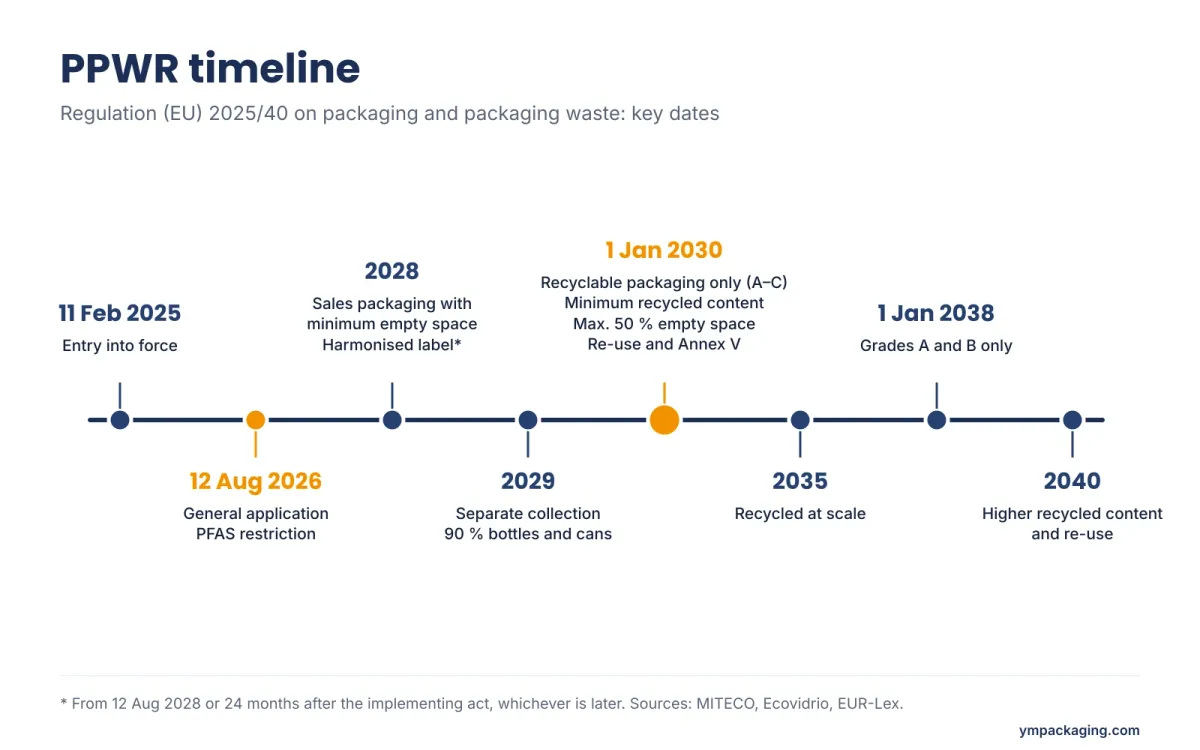
PPWR timeline: key dates from 2025 to 2040
The first key date has already passed: the PPWR has applied since 12 August 2026. The next big date for packers is 1 January 2030.
In 2026, the only things that change in production are the PFAS restriction and the start of application of the regulation; most design requirements arrive in 2030 and tighten in 2038 and 2040.
| Date | What changes | Article | What to check on the packaging line |
|---|---|---|---|
| 11 Feb 2025 | Entry into force | art. 71 | Nothing yet |
| 12 Aug 2026 | General application; PFAS restriction in food-contact packaging | arts. 71 and 5 | Ask your film supplier for the declaration of conformity |
| 2028 | Sales packaging with minimum empty space (12 Feb); harmonised material label (from 12 Aug, depending on the implementing act) | arts. 24 and 12 | Space in the bag or case design for the new label |
| 2029 | Separate collection of at least 90 % of plastic bottles and beverage cans (deposit return systems) | art. 50 | Only affects beverage bottles and cans |
| 1 Jan 2030 | Recyclable packaging only (grades A, B, C); minimum recycled content; minimisation; max. 50 % empty space in grouped, transport and e-commerce packaging; Annex V formats banned; re-use targets | arts. 6, 7, 10, 24, 25 and 29 | Mono-material film and sealing, bag size, dosing, right-sized cases, reusable pallets and crates |
| 2035 | Recycled at scale | art. 6 | Choose materials with a real recycling stream |
| 1 Jan 2038 | Grades A and B only | art. 6 | Review the film structure again |
| 2040 | Higher recycled content (50 %, 25 %, 65 %, 65 %); 70 % re-use in transport (indicative target) | arts. 7 and 29 | Trials with films with more recycled content |
Sources: MITECO, clarification note, MITECO, sustainability and labelling requirements and Ecovidrio, timeline.
In addition, each Member State must cut packaging waste per person by 5 % by 2030, 10 % by 2035 and 15 % by 2040 compared with 2018 (art. 43, Ecovidrio).
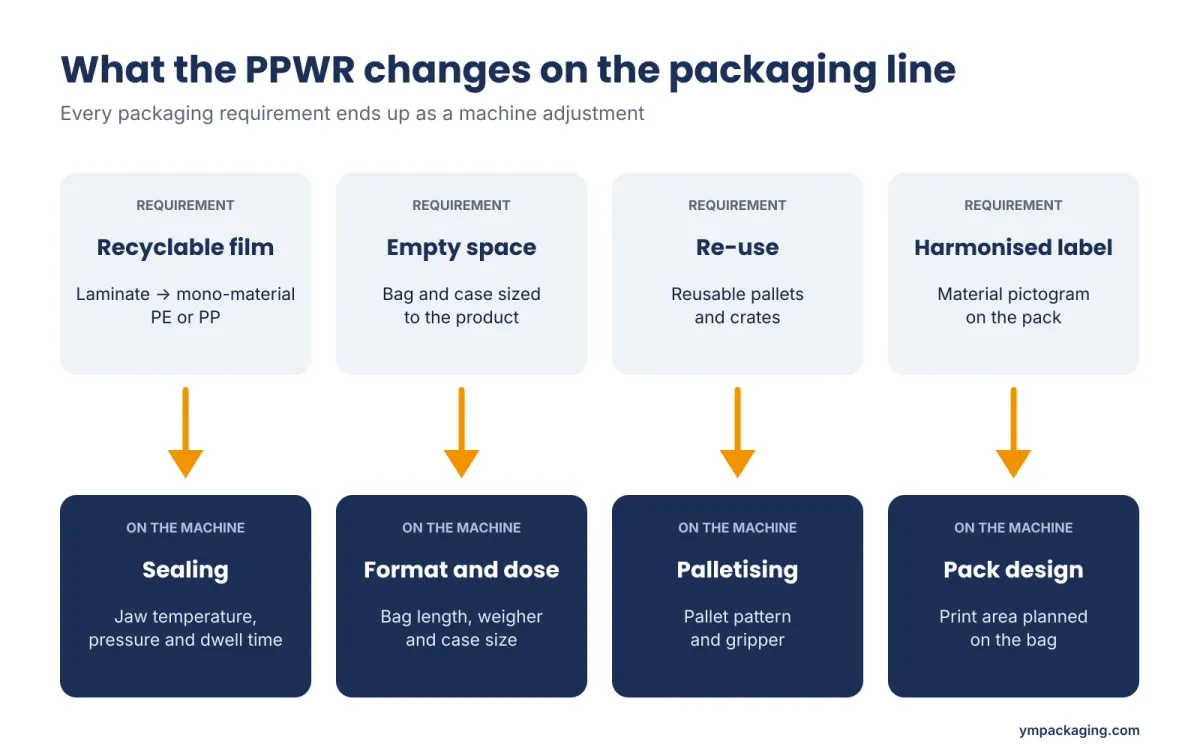
What the PPWR changes on your packaging line
The PPWR does not regulate machines; it regulates packaging. But almost every requirement ends up as an adjustment on the packaging machine: the film, the sealing, the bag size, the dose and the case.
Recyclable film: mono-material and sealing
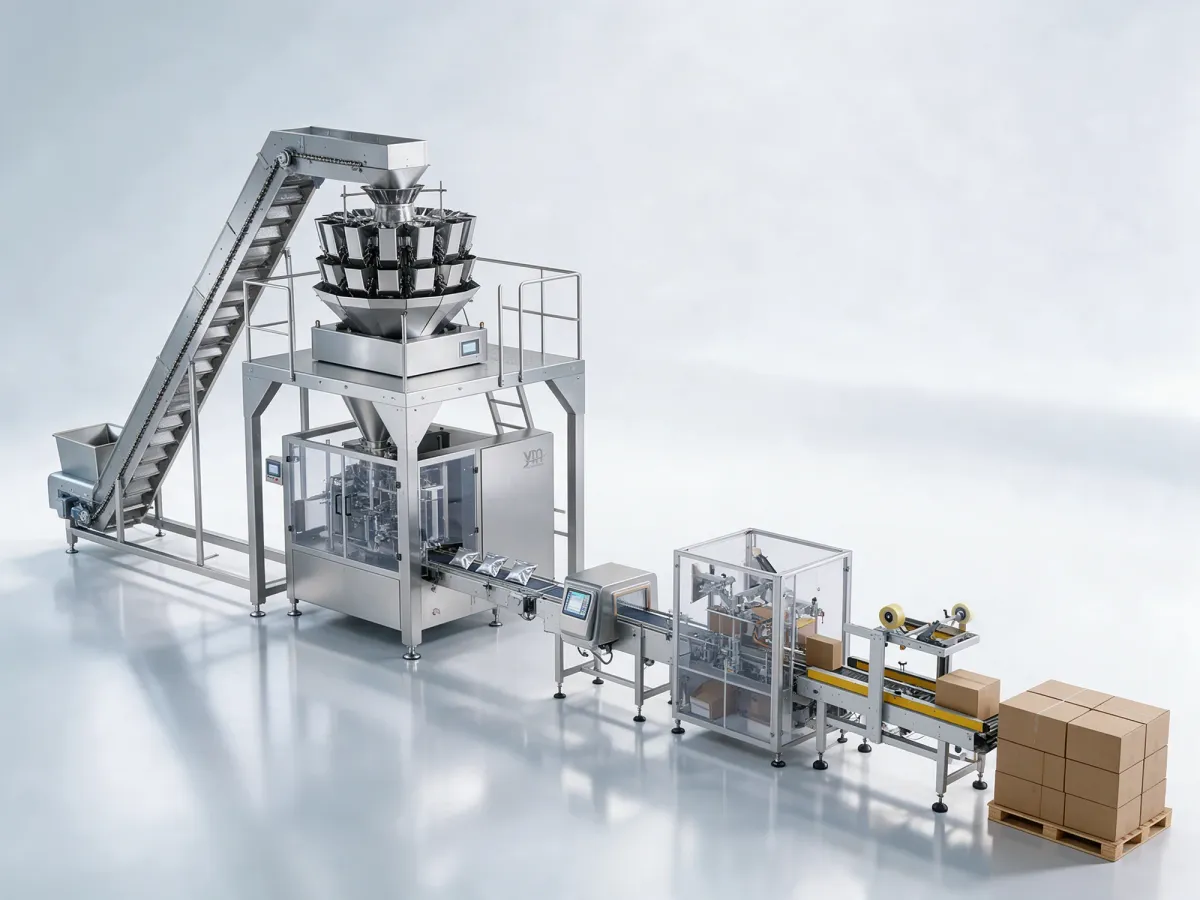
Many bags today use laminated films such as OPP/PE or PET/PE, the same films our vertical packaging machines run ("laminated and single-layer: OPP/CPP, OPP/PE, MST/PE, PET/PE…"). To reach grades A to C, many brands are moving to mono-material PE or PP film, which has a narrower sealing window. On the VM, longitudinal and horizontal sealing is done by jaws with PID-controlled temperature, and a special sealing option for polyethylene is available. The film change also affects horizontal packaging machines. Measure the speed loss during the adjustments with OEE.
Empty space: bag size and dosing accuracy
Less empty space means bags cut to the right length and an accurate dose. The VM vertical packaging machine cuts by length and/or by print mark, with bag widths of 80–190 mm (VM 400), 80–300 mm (VM 620), 240–435 mm (VM 900) and 240–480 mm (VM 1000). To fine-tune the dose, the 4G multihead weigher works from 15 to 7,000 g at 50 to 200 discharges per minute (multihead weighers). Remember that the 50 % limit applies to grouped, transport and e-commerce packaging; in the sales bag, empty space must be the minimum needed.
Grouped and transport packaging: right-sized cases
Cases must fit the product. Among our case packing machines, the F2 case erector handles cases from 250 to 450 mm long at up to 12 cases per minute, the FC3X1 top-load case packer takes cases up to 600 × 400 × 400 mm, and the wrap-around system uses a cardboard blank to wrap the product and form the case around it.
Reusable packaging and pallets
The 2030 re-use targets apply to transport packaging (40 %) and grouped packaging (10 %). The regulation provides exceptions: for example, recital 95 explains why cardboard boxes are left out of the re-use targets, since they allow very few rotations (EUR-Lex). In practice, the PPWR and pallets meet at the end of the line: reusable plastic pallets and crates with a stable pattern and the right gripper. With our automatic palletisers we program the pattern for the pallet your customer uses.
Single portions for hospitality: which formats are banned in 2030
Single-use plastic portions of condiments, sauces, sugar or coffee creamer in hospitality are listed in Annex V. Single portions for retail are not on that list. Producers of HORECA portions will need another material or format. The SV sachet and stick packaging machine runs single doses from 3 to 50 ml, up to 300 sticks per minute, and the trial with the new material is done with your product.
| PPWR requirement | What changes in the packaging | What to check on the machine | YM equipment |
|---|---|---|---|
| Recyclability A–C (2030) | Laminate → mono-material PE or PP, or paper | Sealing temperature, pressure and time; film tension | Vertical and horizontal packaging machines |
| Recycled content (2030) | Film with recycled material | Sealing and pulling trials with the new film | Vertical and horizontal packaging machines |
| Minimisation (2030) | Less weight and volume | Bag length, format change | VM vertical packaging machine |
| Empty space ≤ 50 % in grouped, transport and e-commerce (2030) | Case sized to the product | Case size, packing pattern | Case packing (F2, FC3X1, wrap-around) |
| Sales packaging with minimum empty space (2028) | Shorter bag, accurate dose | Dosing and cut length | Multihead weighers + VM |
| Re-use (2030) | Reusable pallets and crates | Pallet pattern, gripper | Palletising |
| Harmonised label (2028 or later) | New pictogram on the pack | Print area in the bag design | Print area planned in the pack design |
Worked example. A snack producer packs pillow bags in OPP/PE film on a VM 620 vertical packaging machine fed by a 4G multihead weigher, and groups them in cardboard cases. Before 2030 it would need to: 1) move to mono-material PE film and fit the special polyethylene sealing option; 2) check bag length and dose so that empty space is the minimum; 3) resize the case so that empty space stays below 50 %; and 4) leave room on the bag artwork for the harmonised label.
How to prepare for the PPWR: 5 steps
Start with an inventory of your packaging and a trial with the new material on your own machine. If you are wondering how to comply with the PPWR in 2026 and be ready for 2030, follow these steps:
- Packaging inventory by format, material and weight, with its expected recyclability grade.
- Ask your film suppliers for the declaration of conformity (PFAS, heavy metals) and mono-material alternatives.
- Review bag and case sizes against the 2028 and 2030 empty-space rules.
- Test the new film with your product on the packaging machine before changing production. Request information and we will run the trial with you.
- Plan the investment: adjustments, options or a new machine, with deadlines before 2030. Our guide on how to choose a packaging machine helps you decide.
Each Member State keeps its own EPR rules; in Spain, Royal Decree 1055/2022 still applies where it does not conflict with the regulation. In December 2025 the Commission also proposed (COM(2025) 982) to suspend the obligation to appoint an EPR authorised representative when selling directly to consumers in other Member States; in October 2026 Parliament and Council set their positions and the proposal is still being negotiated, so for now the obligation stands.
General information, not legal advice. See the official text of Regulation (EU) 2025/40 on EUR-Lex.
Does your packaging have to change before 2030?
Send us your film and your product: we test them on our machines and tell you what adjustments your line needs. At YM Packaging Group, a Spanish manufacturer of packaging machinery and turnkey lines, we adapt sealing, format and end of line to the new packaging. Request information.
Frequently asked questions
What is the PPWR?
It is Regulation (EU) 2025/40 on packaging and packaging waste (Packaging and Packaging Waste Regulation). It replaces Directive 94/62/EC and has applied directly in every EU country since 12 August 2026.
When does the PPWR apply?
It entered into force on 11 February 2025 and has applied generally since 12 August 2026. Many obligations come later: the main design rules (recyclability, recycled content, empty space and re-use) apply from 2030.
Which packaging must be recyclable, and when?
All of it. From January 2030 only packaging with recyclability grade A, B or C can be placed on the market, and from January 2038 only grade A or B.
How much empty space can packaging have under the PPWR?
From 1 January 2030, grouped, transport and e-commerce packaging can have at most 50 % empty space. In sales packaging, empty space must be reduced to the minimum needed for its function.
Does the PPWR mean I have to change my packaging machine?
It does not regulate machines, but it does regulate packaging. Moving to mono-material film, tighter bags or right-sized cases usually means adjusting the sealing, the format or the dosing. In many cases adjustments or options are enough; the best approach is to test the new film with your product before deciding.
Do national packaging rules still apply?
Yes, where they do not conflict with the regulation. Each Member State keeps its own extended producer responsibility (EPR) rules; in Spain, Royal Decree 1055/2022 still applies where it does not conflict with the regulation.