
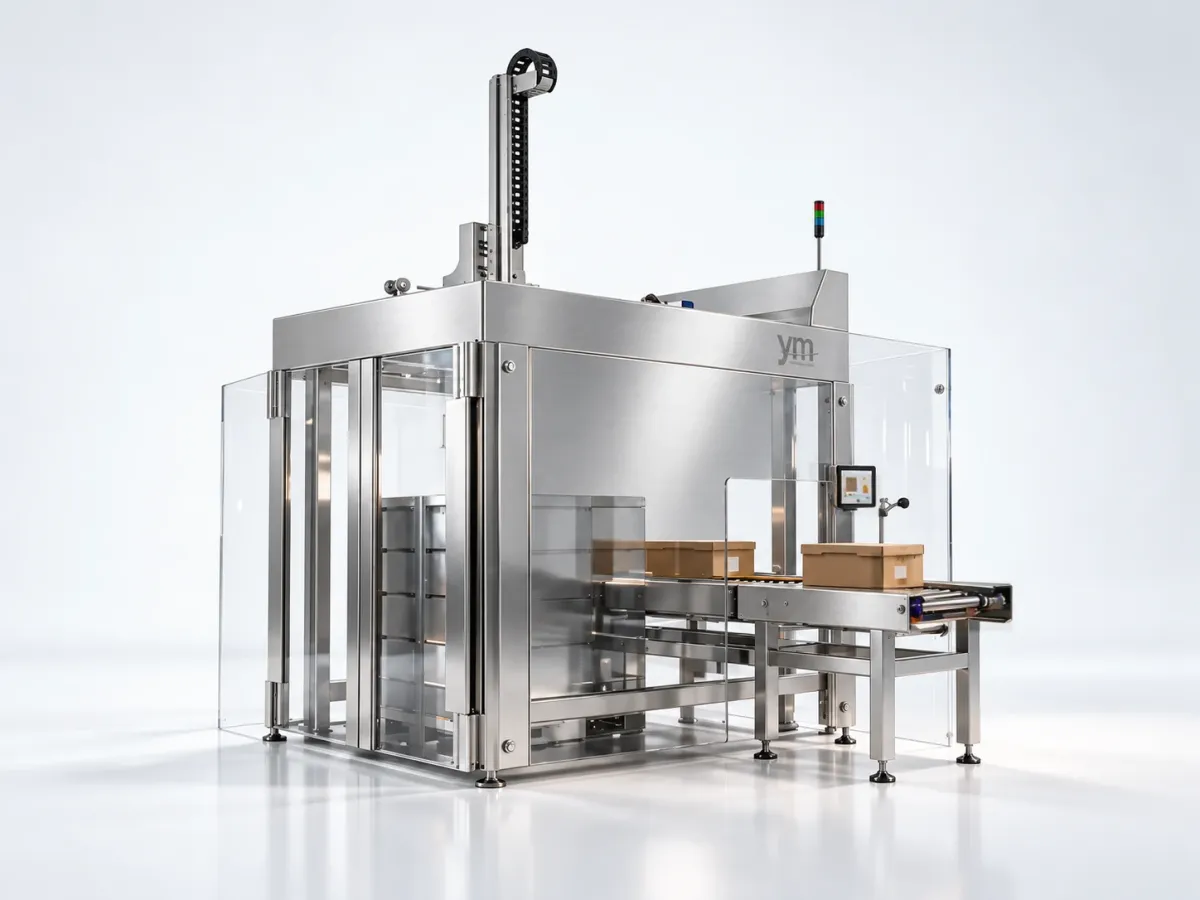
Secondary packaging
Automatic palletising: palletisers and palletising robots
We design and build automatic palletising systems for the end of the line: cartesian palletisers, anthropomorphic palletising robots and collaborative robots. Every project is studied to order: we adapt to your floor space, product, pallet pattern and output, and we optimise palletising times.
The result is an end of line that is safer and more ergonomic for your operators: the automatic palletiser takes over the repetitive, heavy work of lifting cases.
Range: Palletising
3 models
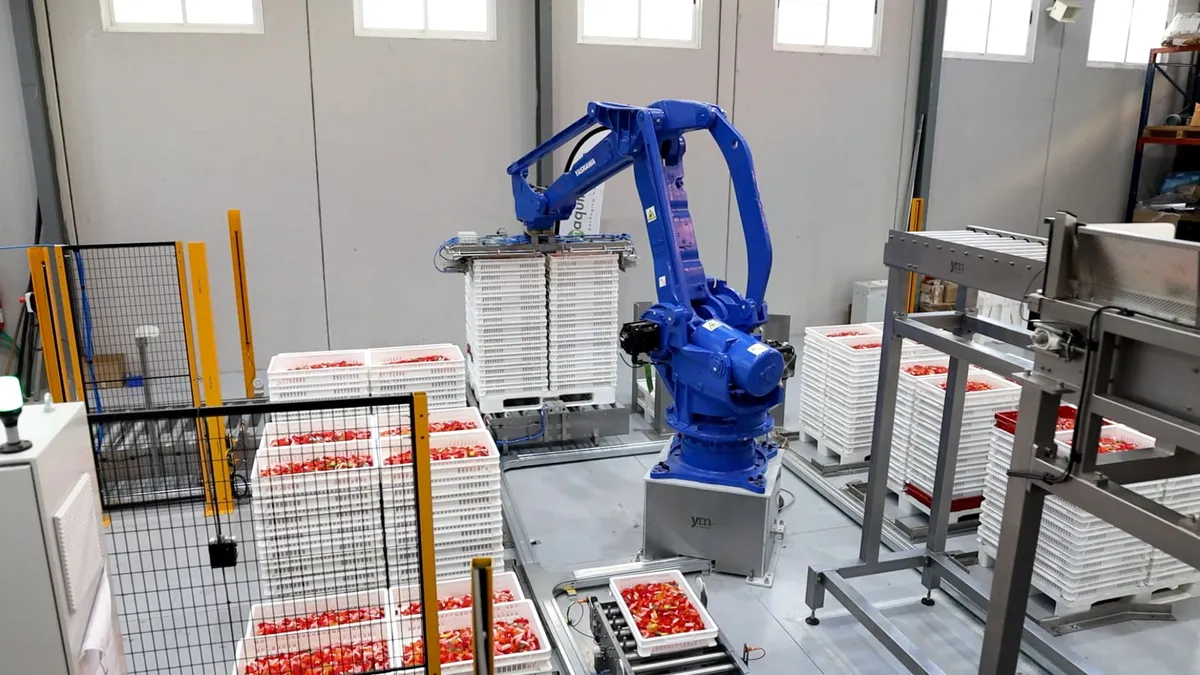
Anthropomorphic robot
Anthropomorphic palletising robot
- Gripper
- Bespoke
- Palletise, depalletise, mix
- 3 in 1
- Patterns
- Complex
See machine
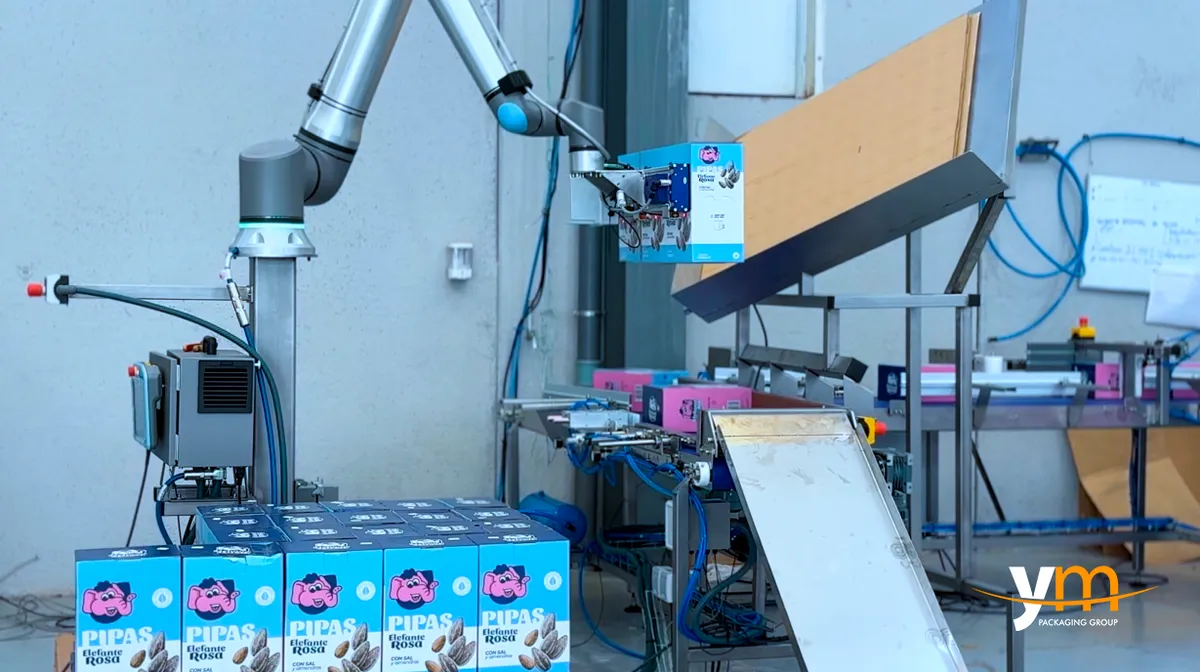
Collaborative robot
Collaborative palletising robot
- Installation
- No cage
- Safety stop
- On contact
- Format change
- Quick
See machine
What is automatic palletising
Palletising means stacking cases or packs on a pallet in a stable pattern, layer by layer, for storage and transport. In automatic palletising a palletising machine or a palletising robot does it, so operators no longer lift and place each case.
Automating industrial palletising brings three things: safety (no more repetitive lifting that causes injuries), steady productivity (stable cycles, without the errors or fatigue of manual palletising) and an orderly end of line, integrated with case packing, checkweighing and case sealing.
Types of palletiser: which to choose
We work with three palletising systems, chosen for the product, pattern, output and floor space:
| Cartesian palletiser | Anthropomorphic palletising robot | Collaborative robot (cobot) | |
|---|---|---|---|
| Motion | 3-axis linear gantry (X, Y, Z) | Articulated arm that turns, flips and orients | Lightweight arm that works alongside people |
| Product | Cartons and regular-shaped packs | Cases, trays, packs and irregular packs | Cartons and packs |
| Patterns | Simple, repeated layer by layer | Complex, interlocked or mixed SKUs | Quick change of format and pattern |
| Functions | Palletising | Palletising, depalletising and mixing | Palletising and case packing |
| Safety | Safety barriers and swing door | Fenced cell | No closed cage, subject to risk assessment |
| Best for | Compact, economical solution, up to 10 cycles/min | Varied products and complex lines | Small spaces and working with operators |
Case palletising robot: anthropomorphic or collaborative
Anthropomorphic palletising robot. An articulated arm with a custom gripper that turns, flips and orients each case to build patterns a cartesian system cannot. The same robot can depalletise incoming product, mix SKUs on one pallet and feed a weighing line. We design the whole cell: robot, gripper, conveyors, fencing and pattern programming, with premium industrial robots such as Yaskawa.
See the anthropomorphic palletising robot · Guide: anthropomorphic robots in palletising
Collaborative robot (cobot). The most compact robotic palletising: the cobot picks each case from the conveyor with a vacuum gripper and places it on the pallet alongside your operators. Its sensors stop it on contact with a person, so it can work without a closed cage, depending on the risk assessment of each installation, and it is quickly reprogrammed for new case formats and patterns.
See the collaborative palletising robot · Guide: collaborative robots in palletising
Industrial cartesian palletiser
The cartesian palletiser is our most compact and economical industrial palletiser: a 3-axis linear gantry picks each carton or regular pack from the conveyor and places it on the pallet layer by layer, with simple patterns and up to 10 cycles per minute. It is the most direct way to move from manual palletising to an automatic palletiser, with safety barriers and a swing door to bring pallets in and out.
How an automatic palletising system works
- Infeed. Sealed cases arrive on the conveyor from the case sealer or checkweigher; a stop holds them in position. With a robot they can also be picked from an incoming pallet (depalletising).
- Pick. The gripper, custom-designed or vacuum, takes the case without damaging it.
- Transfer and orientation. The gantry or arm takes the case to its place in the pattern; a robot can turn it to build interlocked patterns.
- Pallet build. Cases are placed layer by layer, even mixing SKUs on one pallet with a robot.
- Pallet out. The full pallet leaves through the enclosure door or the protected area and an empty one is put in place.
What we palletise
- Cartons and regular-shaped packs.
- Trays of fresh produce.
- Packs, grouped or of different shapes.
- Jar palletising: jars come off the jar filling machine, are grouped in cases or packs and reach the palletiser that way.
Complete palletising line
We design the whole end of line so the product reaches the pallet without manual handling:
- Case erector: forms the case automatically.
- Case packing: a robotic arm places the product in the case.
- Checkweigher: checks every case.
- Automatic case sealer: closes the case.
- Palletiser: builds the pallet to the pattern.
If you want the whole line, from packing to pallet, from one supplier, see our turnkey packaging lines.
Bespoke palletising study
- We study your current process and floor space.
- We optimise palletising performance and the space taken.
- We configure the palletising system for the product, pattern and output.
- Bespoke finishes: safety barriers, swing door to bring pallets in and out, fencing, conveyors.
Tell us about your palletising project and we will propose a solution.
Robotic palletising on video
Real end-of-line projects with palletising: an anthropomorphic robot that depalletises, mixes and weighs product, and a collaborative robot palletising cases on a Euro pallet.
Frequently asked questions
What is palletising?
Placing cases or packs on a pallet, layer by layer and in a stable pattern, for storage and transport. When a machine or robot does it, it is called automatic palletising.
What is a palletiser?
The machine that builds the pallet automatically: it picks each case from the conveyor and places it in its position in the pattern. It can be a cartesian gantry, an anthropomorphic robot or a collaborative robot.
Which palletiser do I need?
It depends on the product, pattern, output and floor space. The cartesian palletiser is the most compact and economical option for regular cases and simple patterns; the anthropomorphic robot handles almost any goods and complex patterns; the cobot works alongside operators without a closed cage. We study each project to order.
How fast is the cartesian palletiser?
Up to 10 cycles per minute, with simple patterns of cartons or regular-shaped packs.
What is a palletising robot?
An industrial robot that picks cases with a gripper and places them on the pallet. The anthropomorphic one works in a fenced cell and can also depalletise and mix SKUs; the collaborative one shares space with people and stops on contact.
Does a collaborative robot need fencing?
In most installations it does not need a closed cage, because its sensors stop it on contact. Final protection is defined by the risk assessment of each installation.
Can jars be palletised?
Yes, grouped: jars from the filling machine are placed in cases or packs and the palletiser builds the pallet with them.
Can you integrate palletising with my packaging line?
Yes. We design the whole end of line: case erecting, case packing, checkweighing, case sealing and palletising, integrated with the equipment you already have.
We design the complete line
Weighing, packing, quality control, case packing and palletising from one supplier.