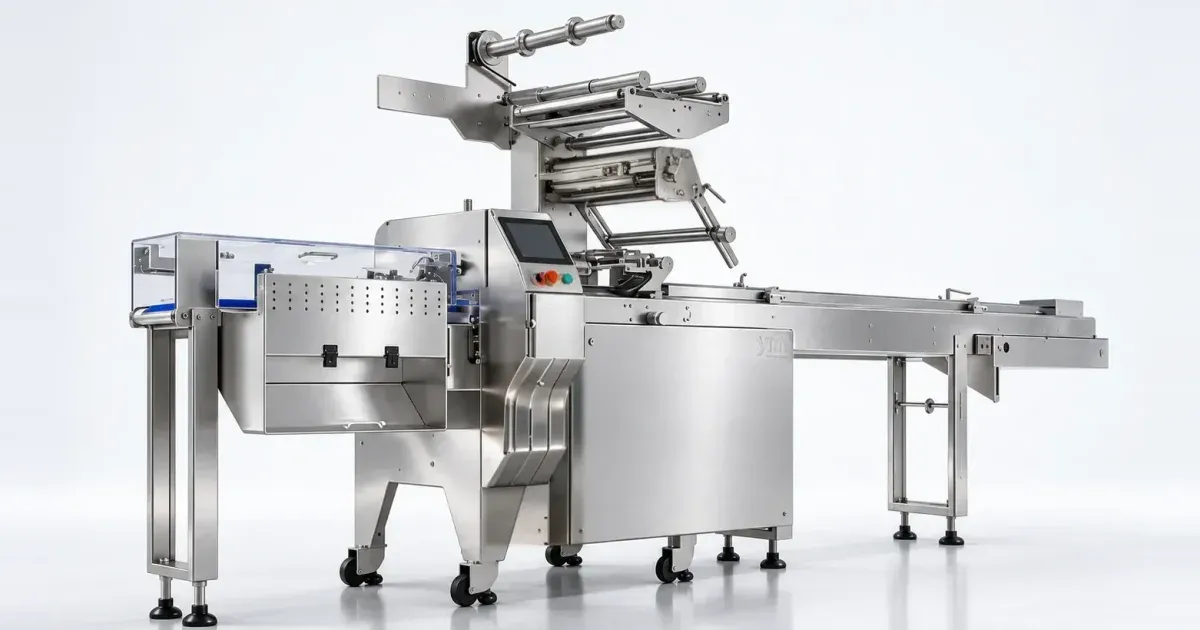
A flow wrapper wraps solid products horizontally as they arrive one by one or in groups. Pushers carry the product into the film, which wraps around it to form a tube; the machine seals the longitudinal fin, seals both ends and cuts between one product and the next. The result is a pillow pack that fits the product closely.
This guide explains it step by step: the six stages of the process, the parts of the machine, the jaw types of each series and the difference between standard and inverted flow wrappers. It is written by YM Packaging Group, a Spanish manufacturer of flow wrapping machines and turnkey lines.
What a flow wrapper is (HFFS)
It is a horizontal packaging machine that forms the bag from a reel of film around each product, then seals and cuts it. That is why its technical name is HFFS (horizontal form fill seal).
For the pack format itself and where it is used, see our guide to flow wrapping. The difference from a vertical machine fits in one line: a flow wrapper wraps solid products that arrive one by one; a vertical machine doses loose product from above. We compare both in vertical vs horizontal packaging machines. We explain the vertical machine step by step in how a VFFS machine works.
How it works, step by step
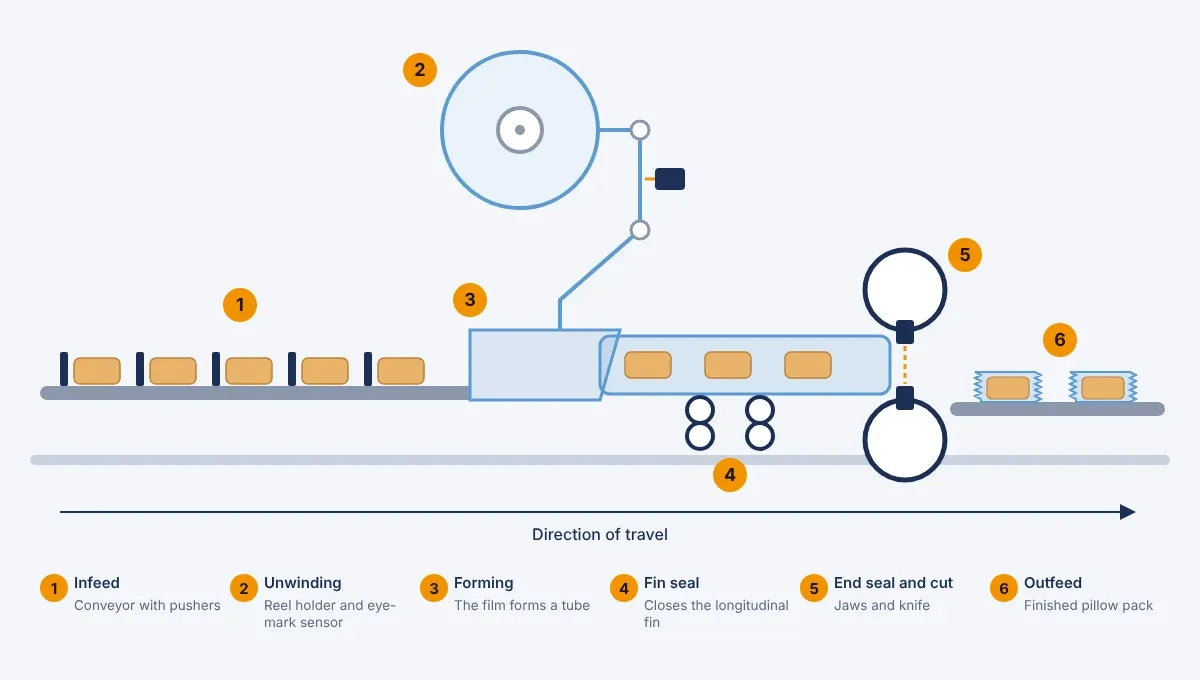
A flow wrapper works in six steps: infeed, film unwinding, forming, fin sealing, end sealing and cutting, and outfeed. Everything happens continuously, one product after another.
1. Infeed
The product is placed on the infeed conveyor (2500 mm on the FP flow wrapper, 2900 mm on the FPI inverted flow wrapper) and the pushers carry it, evenly spaced, to the forming area. The inverted version has no pushers: a belt with a product-position sensor does the job.
2. Film unwinding
A self-centring reel holder feeds the film. With printed film, the eye-mark sensor reads the mark on each bag and keeps the design in place, bag after bag.
3. Forming
The forming box folds the film around the product and makes a continuous tube. From here on, the product travels already wrapped.
4. Fin seal (longitudinal seal)
The longitudinal sealing unit closes the fin underneath the bag, with PID-controlled temperature (±0.5 °C). On an inverted flow wrapper the fin is on top, sealed by two pairs of rollers, each with its own temperature control.
5. End seal and cut
The cross-sealing jaws seal the end of one bag and the start of the next, and the knife cuts between products. Each bag ends up with three seals: one longitudinal and two transverse. The jaw type depends on the series (see the table below).
6. Outfeed
The finished pack leaves on the outfeed belt towards quality control or case packing. With the no product, no bag function (FPS, FPI, FPIS and FPBM), the machine does not make a bag when no product arrives.
Parts of a flow wrapper and what each one does
| Part | What it does |
|---|---|
| Infeed conveyor with pushers | Carries the products at a set pitch into the film |
| Self-centring reel holder | Holds the reel and feeds the film |
| Eye-mark sensor | Keeps the printed design in place on every bag |
| Forming box | Folds the film around the product and forms the tube |
| Longitudinal sealing unit | Closes the fin of the bag |
| Cross-sealing jaws and knife | Seal the ends and separate the bags |
| Outfeed belt | Carries the finished pack out |
| PLC and touch screen | Control the machine and the sealing temperature, and store the programs for each product (99 on the FPI and FPIS) |
Jaw types: what changes between series
The main difference between series is how they make the end seal. This is how our five flow wrapper series seal and cut:
| Series | End seal | Max. speed (data sheet) |
|---|---|---|
| FP | Cross-serrated jaw and zigzag knife | 60 bags/min |
| FPS (3 servo motors) | Cross-serrated jaw and zigzag knife | 80 bags/min (100 on the biscuit version) |
| FPI (inverted) | Rotary jaw with fixed knife | 60 bags/min (FP600I) |
| FPIS (inverted, servo) | Rotary jaw with fixed knife (Teflon-coated on the FP900IS) | 90 bags/min (FP450IS); 30 with shrink film (FP900IS) |
| FPBM | Box Motion jaws, with cross-serrated seal and zigzag knife | 60 bags/min (FP600BM) |
The FPBM Box Motion flow wrapper stands out because its jaws do not rotate: they travel with the bag while they seal, so the seal lasts longer. That makes it the choice for tall or delicate products, or products that need a hermetic seal. On the FPS servo flow wrapper, the pushers, the film rollers and the jaws each have their own servo motor and are set separately: more accurate film and product positioning, and more flexible format changes.
Speeds are the data-sheet maximums; the real speed depends on the product and the film. To choose a series for your product, see our flow wrapping machine series.
Standard or inverted flow wrapper
On a standard flow wrapper the film comes from above and the fin seal is underneath; on an inverted one the film comes from below and the seal is on top.
On the inverted flow wrapper (FPI and FPIS) the reel sits at the bottom and the product rests on the film. With easy access for cleaning and every part in contact with the product made of stainless steel, it is the more hygienic design for fresh or moist products. The FPIS also works with shrink film (FP900IS), with a shrink tunnel straight after it.
The standard version (FP, FPS and FPBM) moves the product with pushers and is the usual choice for bakery, biscuits, bars and non-food products.
Which films and sizes it takes
A flow wrapper works with reel film: heat-seal, laminated (for example OPP + PE) or cold-seal, plain or printed with an eye mark. The FP and FPS are prepared for inert gas (modified atmosphere, MAP) and the FPBM offers it as an option; all three are prepared for a printer.
- The model number is the reel width. Each series has a standard range from 200 to 1000 mm (FP200 to FP1000), and we build any other size to order.
- Maximum product size (length × width × height): 500 × 280 × 80 mm on the FP600; 550 × 330 × 150 mm on the FP700S; 500 × 320 × 80 mm on the FP600I.
Which flow wrapper suits your product?
Want to know which flow wrapper suits your product? Tell us about your case and we will recommend the series. Contact us and, if you send us your product and your film, we will test them on our machines.
Frequently asked questions
What does HFFS mean?
Horizontal form fill seal. It is the technical name of the flow wrapper, which forms the bag from a reel of film around the product, seals it and cuts it in a single machine.
How many seals does a flow wrap bag have?
Three: one longitudinal fin seal along the bag and two end seals, one at each end. That is why it is also called a pillow pack.
How fast is a flow wrapper?
It depends on the series and the product. The FP reaches 60 packs per minute, the FPS 80 (100 on the biscuit version) and the FPIS 90 (FP450IS).
What is the difference between a flow wrapper and a vertical packaging machine?
A flow wrapper wraps solid products horizontally as they arrive one by one or in groups. A vertical machine fills loose product (granules, powder or liquid) from above, dosing it into the bag.