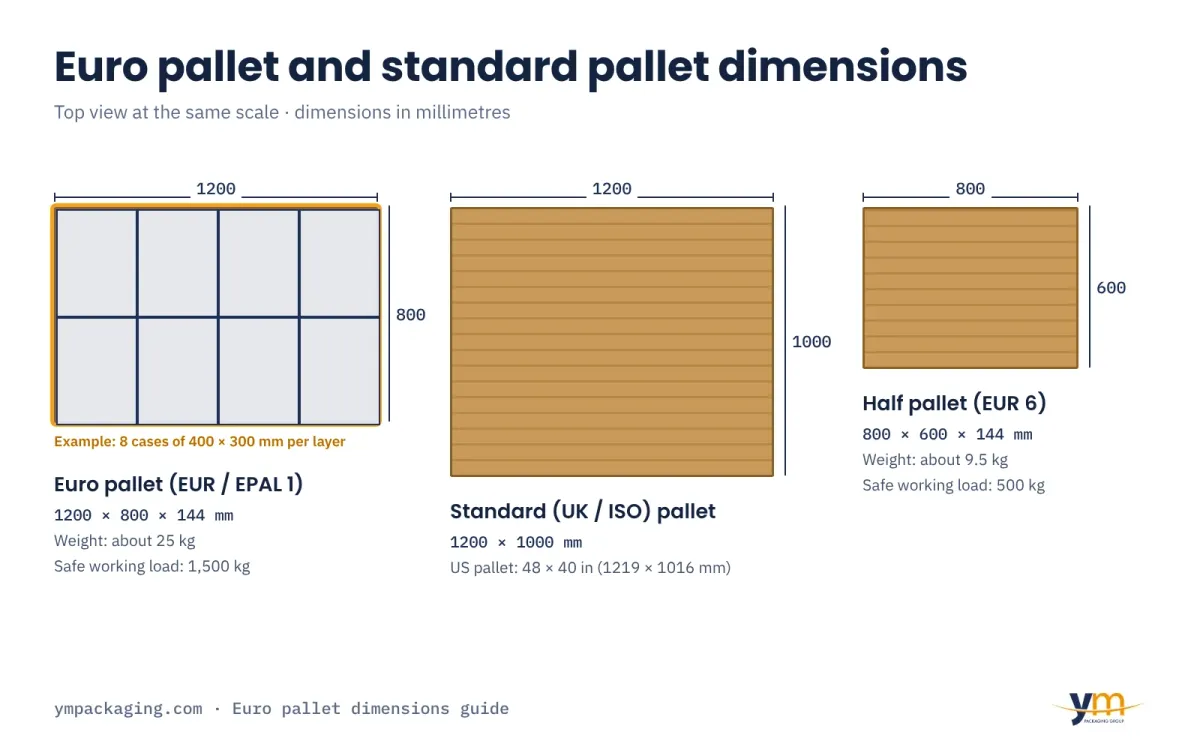
A Euro pallet (EUR or EPAL 1) measures 1200 × 800 mm, is 144 mm high and weighs about 25 kg. The standard pallet used in the UK and many industries (ISO, sometimes called "American") measures 1200 × 1000 mm.
Size tables are everywhere; what hardly anyone explains is what to do with those dimensions at the end of the line. This guide gives you the dimensions, weight and load of each pallet, and how to use them to palletise cases: choosing the pattern, working out the layers and stabilising the load, by hand or with a palletiser.
Euro pallet dimensions (EPAL / EUR pallet)
The Euro pallet, also called EUR pallet or EPAL pallet, is the most widely used standardised wooden pallet in Europe. Its dimensions are always the same:
| Item | Euro pallet (EUR / EPAL 1) |
|---|---|
| Length | 1200 mm |
| Width | 800 mm |
| Height | 144 mm |
| Empty weight | about 25 kg |
| Safe working load | 1,500 kg, evenly distributed |
| Stacking load | up to 4,000 kg on the bottom pallet, on a flat floor |
EPAL (European Pallet Association) is the association that licenses the manufacture and repair of the Euro pallet. A genuine EPAL pallet carries the EPAL mark on its blocks and is built from 11 boards, 9 blocks and 78 nails in a fixed pattern, so it can be exchanged with any other EPAL pallet. It is a four-way pallet: a forklift can enter from all four sides, and a pallet truck from the two short sides.
Euro pallet weight and maximum load
How much does a Euro pallet weigh? About 25 kg empty; a very dry pallet can be closer to 20 kg. Count that weight in the gross weight of every shipment.
The load it takes depends on how the pallet is working:
- Safe working load (dynamic): 1,500 kg spread evenly over the whole surface, while it is moved by forklift or pallet truck. If the load is not evenly spread, the limit drops to about 1,000 kg.
- Stacking load (static): with loaded pallets stacked on a flat, firm floor, the bottom pallet can carry up to 4,000 kg on top.
- On racking: it depends on the type of racking and how the pallet is supported. The racking manufacturer sets it according to its standards (EN 15512 and EN 15620).
Pallet height and maximum load height
The height of a Euro pallet is 144 mm. The maximum height of a loaded pallet, however, is not a fixed figure. Three things decide it:
- The transport. Each carrier sets its own limit and always counts the pallet. As a reference, some carriers accept 180 cm in a closed van, 220 cm on groupage and 270 or 300 cm on a full truck load, depending on the vehicle.
- The warehouse. The clear height of each racking bay, which your customer or logistics provider will give you.
- Stability. The taller and narrower the pallet, the easier it is for it to deform or tip over on bends and under braking. If the case is light or soft, lower the height or reinforce the stabilisation.
So before you define the pattern, always ask for the maximum delivery height: it is the figure that sets how many layers fit.
Euro pallet vs standard pallet
The standard pallet (UK / ISO, also called "industrial" or "American") measures 1200 × 1000 mm: the same length as the Euro pallet and 20 cm wider. It has more surface but does not follow the EPAL exchange system, and its weight and load depend on each manufacturer. In the United States the standard pallet is different again: 48 × 40 inches (1219 × 1016 mm).
| Type | Dimensions | Approx. weight | Typical use |
|---|---|---|---|
| Euro pallet (EUR / EPAL 1) | 1200 × 800 × 144 mm | 25 kg | Retail and FMCG distribution in Europe |
| EUR 3 | 1000 × 1200 × 144 mm | 30 kg | Industry, wider loads |
| Half pallet (EUR 6) | 800 × 600 × 144 mm | 9.5 kg | Supermarkets, display pallets |
| Standard (UK / ISO) pallet | 1200 × 1000 mm | depends on the maker | Drums, sacks, chemicals and industry |
Two EUR 6 half pallets take up the same space as one Euro pallet, and three Euro pallets fit across the width of a standard semi-trailer (3 × 800 = 2400 mm): 33 pallets in total. If your customers receive on Euro pallets, design the case around those 1200 × 800 mm.
Other types of pallets
As well as by size, types of pallets differ by material and use:
- Half pallet (800 × 600 mm) and quarter pallet (600 × 400 mm): for small orders and for displaying the product directly in store.
- Plastic pallets: washable and with a constant weight, widely used in the food and pharmaceutical industries, often in the same size as the Euro pallet.
- Non-EPAL wooden pallets, one-way or in special sizes, for export or specific loads. For export outside the EU, the wood usually needs the ISPM 15 treatment and mark.
How to palletise cases on a Euro pallet
Palletising means placing the cases on the pallet in a stable order, layer by layer, so they can be stored and transported. These are the steps:
- Measure the case: length, width, height and filled weight. A case designed for the pallet saves space: for example, a 400 × 300 mm case covers the base of a Euro pallet exactly with 8 cases per layer, with no gaps or overhang.
- Choose the pattern. The pallet pattern (or stacking plan) is how the cases are placed in each layer. In a column stack, the cases sit directly on top of each other and the case resists stacking better; in an interlocked pattern, each layer is turned relative to the one below and the cases tie together, which gives more stability. Avoid cases overhanging the edge of the pallet.
- Work out the layers: subtract the 144 mm of the pallet from the maximum delivery height and divide by the case height. Example: with a 1800 mm maximum height and 250 mm high cases, (1800 − 144) ÷ 250 = 6.6, that is 6 layers, 48 cases. Then check that the total weight (cases plus pallet) does not exceed the safe working load.
- Stabilise the load with stretch film, edge protectors, strapping or layer pads, depending on weight and height.
- Label the pallet with the logistics label (for example the GS1 label with an SSCC code) on a visible side, to identify and track the load.
On a packaging line, steps 2 and 3 are done by an automatic palletiser at the end of the line, after the case packing machinery:
- The cartesian palletiser places regular cases in simple patterns, up to 10 cycles per minute, and takes up little space.
- The anthropomorphic palletising robot turns and orients each case for complex patterns and mixed pallets with several products.
- The collaborative robot palletises alongside the operators, without a closed cage if the risk assessment of the installation allows it.
In automatic palletising we design the cell for the pallet your customer uses and program the patterns for each case format. To see where the pallet fits in the packaging as a whole, read our guide to types of packaging.
Frequently asked questions
What size is a Euro pallet?
A Euro pallet (EUR or EPAL 1) measures 1200 × 800 mm and is 144 mm high. The Euro half pallet (EUR 6) measures 800 × 600 mm and has the same height.
How much does a Euro pallet weigh?
An empty wooden Euro pallet weighs about 25 kg; depending on how dry the wood is, it can be closer to 20 kg. The EUR 6 half pallet weighs about 9.5 kg.
What is the difference between a Euro pallet and a standard 1200 × 1000 pallet?
The size: the Euro pallet is 1200 × 800 mm and the standard (UK / ISO) pallet is 1200 × 1000 mm, so it is 20 cm wider and has more surface for large loads, drums or sacks. The Euro pallet is the standard for retail distribution in Europe and for pallet exchange systems. The standard pallet in the United States is different again: 48 × 40 inches (1219 × 1016 mm).
What is the maximum height of a loaded pallet?
There is no single maximum height: it depends on the transport, the warehouse racking and the stability of the load. As a reference, some carriers limit a pallet to 180 cm in a van, 220 cm on groupage and 270 cm or more on a full truck load, always including the 144 mm of the pallet. Check the limit with your haulier and your customer before you set the pallet pattern.