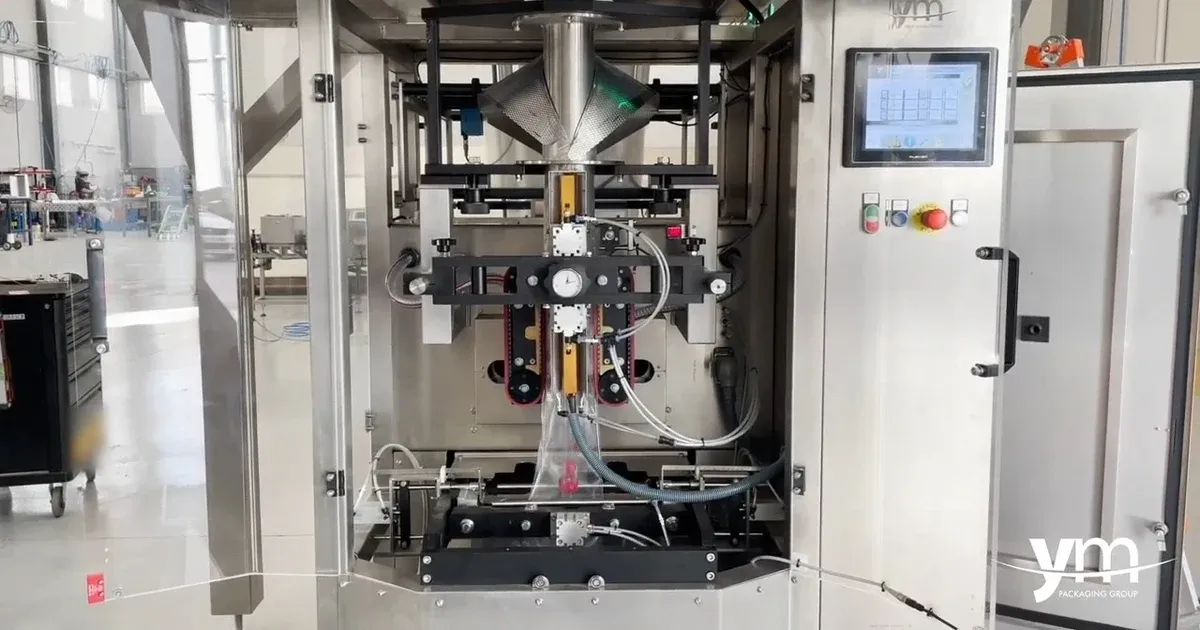
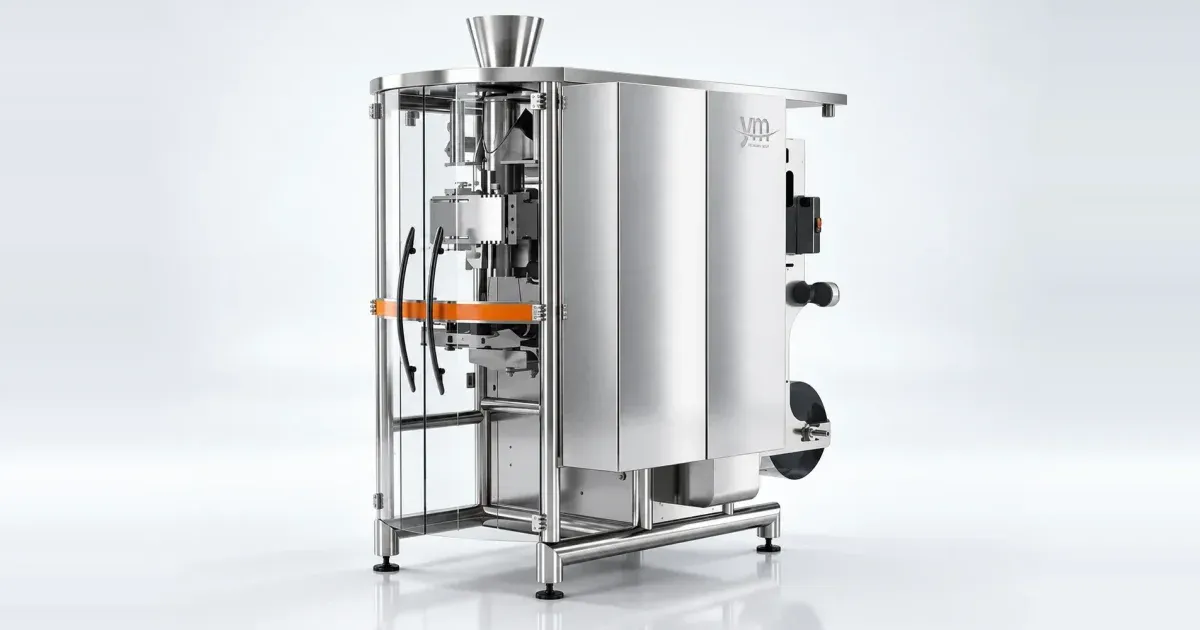
A vertical form fill seal (VFFS) machine forms the bag from a reel of film, fills it from above and seals it. The film runs over the forming tube and is sealed vertically, the dosed product drops through the inside of the tube, and the horizontal jaws close the bag, make the bottom of the next one and cut it.
This guide explains it step by step: the six stages of the process, the parts of the machine, the difference between intermittent and continuous motion, and the bags it can make. It is written by YM Packaging Group, a Spanish manufacturer of vertical packaging machines and turnkey lines.
What a VFFS machine is
It is a machine that forms, fills and seals the bag in one unit, starting from a reel of film. Its technical name is VFFS (vertical form fill seal).
It works vertically for two reasons: the product falls into the bag by gravity, and film on a reel is cheaper than premade bags. It also takes little floor space. If you are weighing it against a horizontal system, we compare both in vertical vs horizontal packaging machines.
How it works, step by step
A VFFS machine works in six steps: film unwinding, forming on the forming tube, dosing, horizontal sealing, cutting and outfeed. It repeats them for every bag, in sync with the doser.
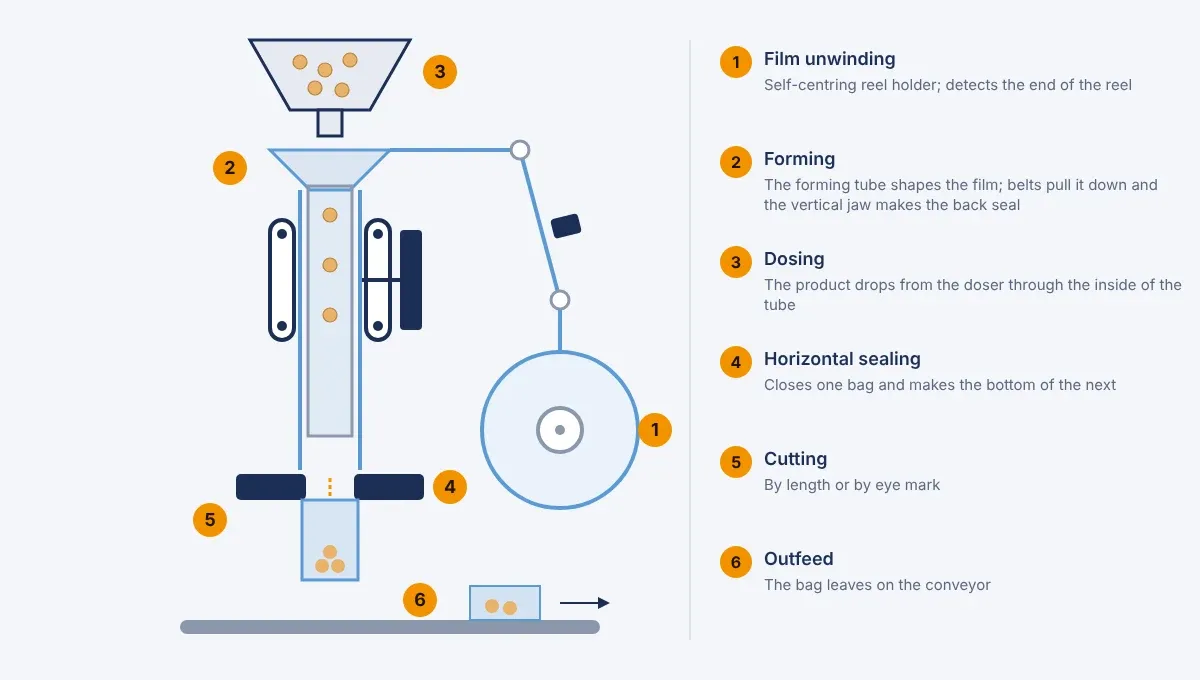
1. Film unwinding
A self-centring reel holder feeds the film. It detects the end of the reel and allows a semi-automatic splice, so reel changes are quick.
2. Forming: the forming tube
The forming tube, made to the size of the bag, turns the flat film into a tube. Servo-driven pull belts draw the film down and the vertical jaw makes the longitudinal seal (the back seal of the bag).
3. Dosing
The product drops from the doser through the inside of the tube. The doser depends on the product:
| Product | Doser |
|---|---|
| Granules and solids | Multihead weigher or volumetric filler |
| Powder | Auger |
| Liquids | Pump |
| Also on the VM | Piston filler |
4. Horizontal sealing
The horizontal jaws close the top of the bag and, at the same time, make the bottom of the next one. Temperature is PID-controlled and air is blown at the jaw for a clean finish.
5. Cutting
The bag is cut by length or by eye mark: a photocell reads the mark printed on the film. An encoder keeps every bag exactly the right length.
6. Outfeed
The finished bag leaves on the conveyor towards the metal detector, the checkweigher and the case packer.
Parts of a VFFS machine and what each one does
| Part | What it does |
|---|---|
| Reel holder | Holds the reel and feeds the film |
| Forming tube | Turns the flat film into a tube |
| Pull belts | Draw the film down |
| Vertical jaw | Makes the back (longitudinal) seal |
| Doser | Weighs or measures the product |
| Horizontal jaws | Seal the top of one bag and the bottom of the next |
| Knife | Separates the bags |
| Eye-mark photocell | Keeps the printed design in place |
| Screen | Controls the machine and the sealing temperature (PID); stores up to 99 recipes, one per format (VM) |
Intermittent or continuous: two ways to move the film
An intermittent VFFS machine stops the film at every bag to seal and cut; a continuous one never stops it, because the jaws travel with the bag while they seal.
- Intermittent. The film advances, stops for sealing and cutting, then advances again. This gives more control over filling and sealing and treats delicate products better. Models: VME, VM vertical packaging machine, VMI, VX and TWIN.
- Continuous. The film never stops: the jaws travel with the bag while they seal. This is the option for high volumes of uniform, free-flowing products. Models: VMC continuous vertical packaging machine, VXC and TWIN C.
| Motion | YM models | Speed (data sheet) |
|---|---|---|
| Intermittent | VME, VM, VMI, VX | Up to 80 bags/min |
| Continuous | VMC, VXC | Up to 120 bags/min |
| Twin tube | TWIN (intermittent), TWIN C (continuous) | Up to 140 (TWIN) and 240 bags/min (TWIN C) |
Speeds are the data-sheet maximums; the real speed depends on the product, the film and the bag length.
Which bags a VFFS machine makes
A VFFS machine makes bags from reel film, from the pillow bag to single-dose packs.
- Formats: pillow bag, flat bottom (gusseted bottom, optional on the VM), four-side-sealed Stabilo (VX and VXC), gable-top bag, strip pack, sachet and stick pack (SV, 1 to 12 lanes).
- Sizes: bags 70 to 480 mm wide and reels up to 1000 mm (VM 1000).
- Films: laminated or single-layer (OPP/CPP, OPP/PE, MST/PE, PET/PE).
For doypack or zipper bags, which are handled as premade bags, see our horizontal packaging machines.
Fragile products: the inclined vertical packaging machine
For fragile products, the VMI inclined vertical packaging machine tilts, so the product slides down the forming tube instead of dropping straight.
The angle is set electronically from the screen, according to how fragile the product is. It runs at 40 to 80 bags per minute depending on the product, the bag length and the tilt, usually with a multihead weigher on top.
Which vertical packaging machine suits your product?
Want to see which vertical packaging machine suits your product and your bag? Tell us about your case and we will recommend the model. Contact us.
Frequently asked questions
What does VFFS mean?
Vertical form fill seal. It is the technical name of the vertical packaging machine, which makes the bag from a reel of film, fills it from above and seals it in a single machine.
Are vertical packaging machines automatic?
Yes. They form, fill, seal and cut the bag without the operator, in sync with the doser. The operator loads the reel and the product and monitors production from the screen.
How fast is a VFFS machine?
It depends on the model and the product. Single-tube intermittent machines reach 80 bags per minute, continuous-motion machines 120 (VMC, VXC) and twin-tube machines 140 (TWIN) or 240 (TWIN C).
Which doser does a VFFS machine need?
A multihead weigher or volumetric filler for granules and solids, an auger for powder and a pump for liquids. YM Packaging vertical machines work with all of them.