
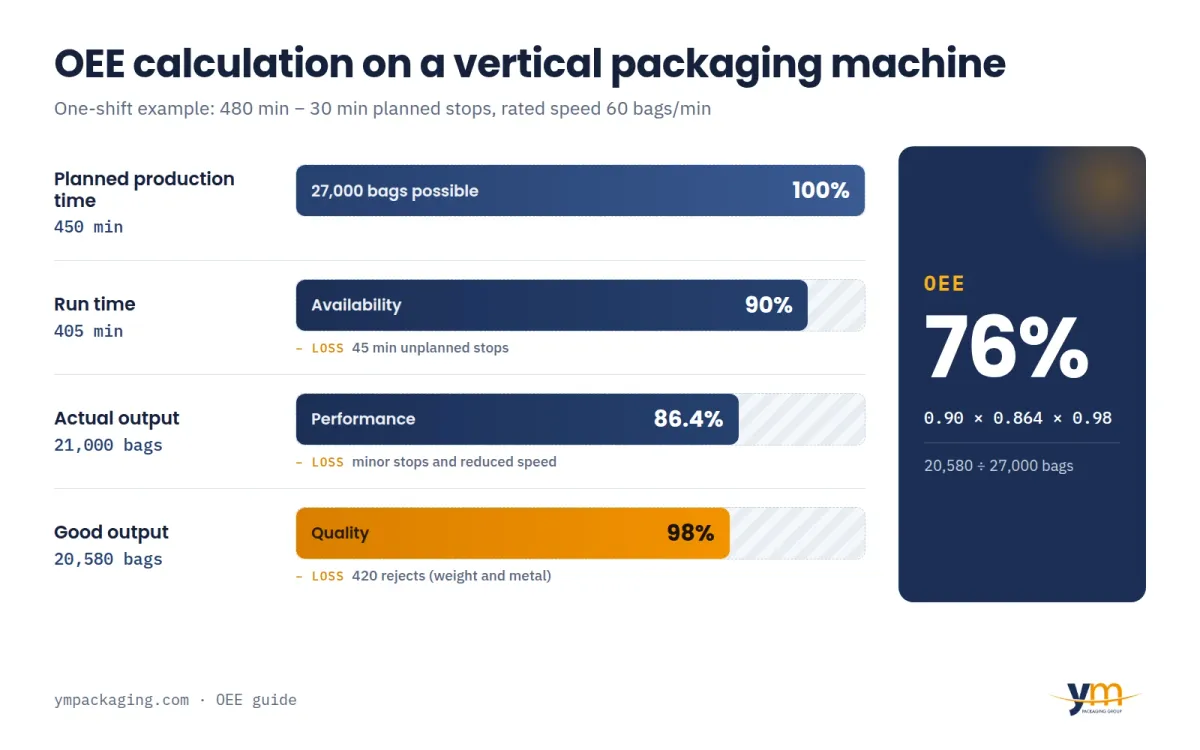
OEE (Overall Equipment Effectiveness) measures what percentage of the planned production time a machine spends making good units at its rated speed. It is calculated as Availability × Performance × Quality: a packaging machine with 90% availability, 86.4% performance and 98% quality has an OEE of 76%.
Most of what is published about OEE comes from maintenance software or MES vendors. Here we explain it from the machine's point of view: a worked example on a vertical packaging machine, the losses you see on a packaging line, and which of them depend on the design of the machine itself.
What OEE is and what it means
OEE stands for Overall Equipment Effectiveness. In French it is called TRS (taux de rendement synthétique). It is a key production indicator (KPI) that grew out of Total Productive Maintenance (TPM) and is now used in any plant that wants to measure how well it uses its machines.
The idea is simple: it compares what the machine actually produced in good units with what it could have produced if it had run for the whole planned time, at rated speed and without a single reject. An OEE of 100% means perfect production: no stops, full speed and no defects. Nobody reaches it in practice, which is exactly why OEE is useful: it shows how much capacity is being lost and where.
You can measure OEE on a single machine (the packaging machine, the weigher) or on a complete line. On a line, the slowest machine or the one that stops most sets the pace, because it holds back all the others.
The OEE formula: availability, performance and quality
The OEE formula multiplies three factors, each expressed as a fraction or a percentage:
OEE = Availability × Performance × Quality
- Availability = run time ÷ planned production time. It captures stops: breakdowns, changeovers, lack of product or materials, waiting.
- Performance = actual output ÷ theoretical output at rated speed during the run time. It captures speed losses: minor stops and running below rated speed.
- Quality = good units ÷ units produced. It captures rejects: bags out of weight, badly sealed, with metal detected or reworked.
Planned stops (breaks, scheduled cleaning, planned maintenance) are taken off the shift time first, so they do not count against OEE. There is a shorter way to calculate OEE that gives the same result: good units ÷ (planned time × rated speed). It is handy for checking the numbers, but it does not show where the loss is, which is why the OEE indicator is always reported with its three factors.
How to calculate OEE: an example on a vertical packaging machine
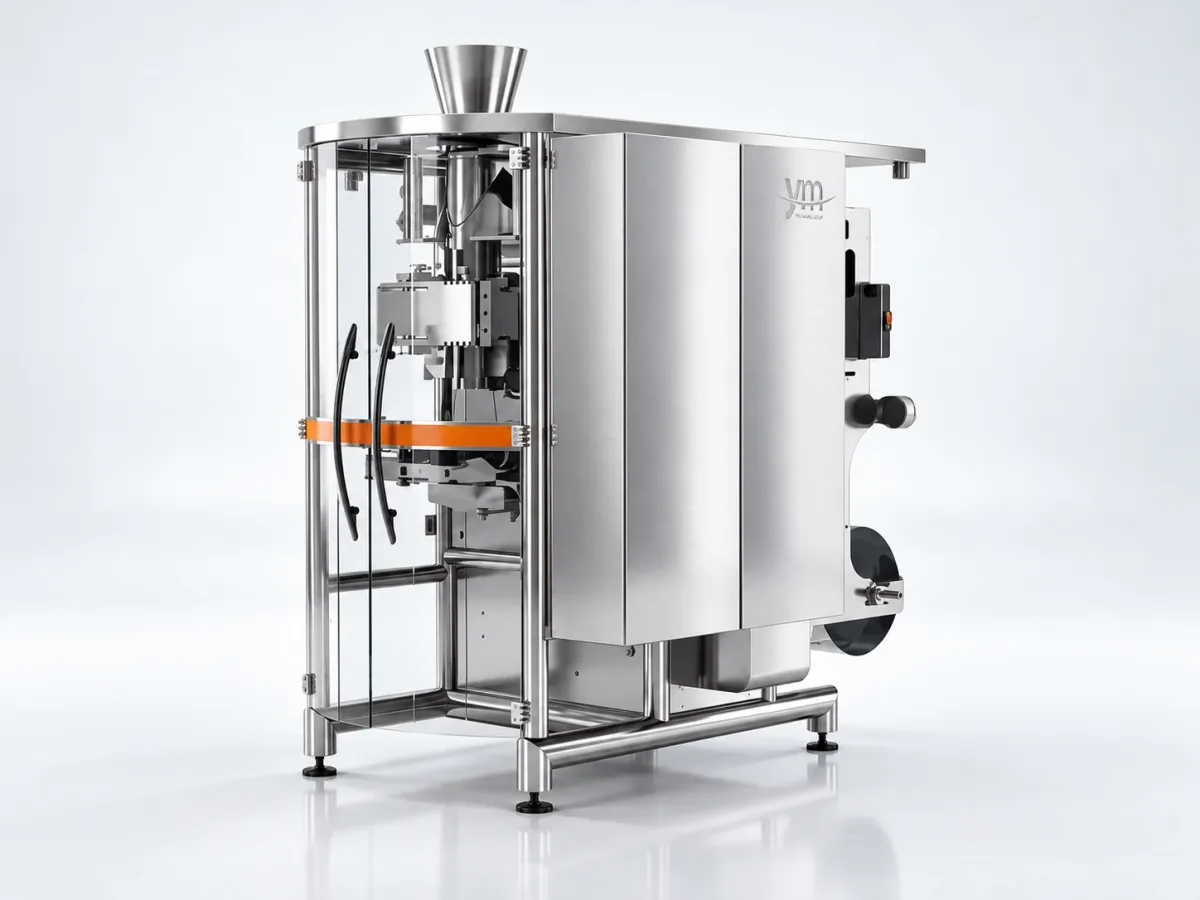
Let's see how to calculate OEE for one shift of a vertical packaging machine making pillow bags, with a multihead weigher, a metal detector and a checkweigher. The figures are a round example to follow the method; the speed of 60 bags/min is within the range of our VM vertical packaging machine (40–90 bags/min depending on the model and the product).
- Planned time. The shift lasts 480 min and has 30 min of planned stops (break and cleaning). That leaves 450 min of planned production time.
- Availability. During the shift there are 45 min of unplanned stops (a reel change and a jam in the sealing jaw). That leaves 405 min of run time: 405 ÷ 450 = 90% availability.
- Performance. At 60 bags/min, the machine could make 24,300 bags in 405 min. It made 21,000 because of minor stops and running below rated speed: 21,000 ÷ 24,300 = 86.4% performance.
- Quality. The checkweigher and the metal detector reject 420 bags. That leaves 20,580 good bags: 20,580 ÷ 21,000 = 98% quality.
- OEE. 0.90 × 0.864 × 0.98 = 76% OEE. Check: 20,580 good bags ÷ (450 min × 60 bags/min = 27,000) = 76%.
Read this way, the result already sets the priorities: the lowest factor is performance. In this shift more bags are lost to minor stops and speed than to breakdowns or rejects, so the first place to look is the doser and the film transport, not the metal detector. For a week's production OEE, add up the times and units of every shift and calculate it the same way.
What is a good OEE?
There is no single number for every plant, but these ranges are the usual reference:
| OEE | What it means |
|---|---|
| Below 65% | Low: a lot of capacity is lost and there are usually stops nobody records. |
| 65–85% | Common on well-run packaging lines, with clear room for improvement. |
| Above 85% | The "world-class" benchmark in TPM; hard to sustain with many changeovers. |
The trend of the same line matters more than the absolute value. A line that packs ten different products a day will have a lower OEE than one dedicated to a single product, and that does not mean it works worse. Compare shifts, products and weeks on the same line, and set the target from its own starting point.
The six big losses on a packaging line
TPM groups everything that lowers OEE into six big losses, two for each factor. On a packaging line they look like this:
- Breakdowns (availability): a sealing-jaw heater, a motor or a photocell that fails. This is what preventive maintenance tries to prevent.
- Changeovers and adjustments (availability): changing the forming tube, the reel width or the product, and the minutes of adjustment until the bag comes out right.
- Minor stops (performance): stops of a few seconds that nobody writes down, such as a doser jam, a product that catches or a bag that is pulled badly. Added up, they are often the biggest and the least visible loss.
- Reduced speed (performance): running at 50 bags/min on a machine capable of 60 because the product is difficult or because it "gives no trouble" that way.
- Rejects and rework (quality): bags out of weight, badly sealed, leaking or rejected by the metal detector.
- Start-up losses (quality): the bags thrown away after a changeover or at the start of the shift, until sealing and bag length settle. Film breaks cost both a stop and lost product.
Some of these losses depend on how the plant is organised, but others are decided when the machine is designed. On the VM, for example, the forming tube changes without tools, the reel holder self-centres, film splicing is semi-automatic and the screen stores 99 recipes, all designed to shorten changeovers. PID-controlled sealing temperature and the encoder that keeps every bag the same length reduce start-up rejects.
How to improve the OEE of a machine
To work out how to improve the OEE of a machine, start with the lowest factor and the biggest loss within it. The usual levers in packaging are:
- Shorter changeovers (SMED). Separate what can be prepared while the machine is running (reel, forming tube, recipe) from what needs it stopped, and standardise the procedure. It raises availability without buying another machine.
- Preventive and predictive maintenance. Check jaws, belts and wear parts before they fail. Our preventive maintenance service and the AVATAR system, which monitors the line's critical variables to step in before a breakdown, tackle unplanned stops directly.
- Remove minor stops. Log every short stop with its cause for a few weeks and fix the three most frequent: doser settings, guides, film sensors.
- In-line quality control. A checkweigher and a metal detector take out the faulty bag without stopping the line, and the reject data shows whether the problem comes from dosing or sealing. More options in quality control.
- Operator training. Many speed and start-up losses disappear when the team sets the machine up the same way on every shift.
- Design the complete line. In a complete packaging line, sizing each machine and the buffers between them properly stops one machine from holding back the rest.
OEE systems: how to measure it automatically
Calculating OEE by hand on a shift sheet is a good start, but minor stops are hardly ever written down and the result looks better than it is. OEE systems take the data straight from the machine:
- PLC counters: bags produced, bags rejected and the machine state (running, stopped, in alarm) second by second.
- Machine screen (HMI): alarms and stops are recorded with their cause. On our packaging machines, the PLC and the screen record stops and production counters, which is the data the OEE calculation needs; on our high-speed range (HFX and EPX), OEE and production data are also shown on the machine's own screen.
- Signals from the inspection equipment: the checkweigher and the metal detector count rejects separately, which is the figure that feeds the quality factor.
- Supervision software or MES: collects the data from every machine on the line and calculates OEE by shift, product and machine.
Before choosing software, check what data each machine already provides and how it can be read from the PLC. If you are considering a new packaging machine or an automated line and want it to measure its OEE from day one, tell us about your project: our technical team will tell you what production data each machine can provide.
Frequently asked questions
What is OEE and how is it calculated?
OEE (Overall Equipment Effectiveness) measures how much of the planned production time a machine spends making good units at its rated speed. It is the product of three factors: OEE = Availability × Performance × Quality. For example, 0.90 × 0.864 × 0.98 = 76%.
What is OEE used for?
It shows the real capacity of a machine or line and where it is lost: in stops (availability), in speed (performance) or in rejected product (quality). That tells you what to improve first and lets you compare shifts, products or machines with the same indicator.
How can you improve the OEE of a machine?
Start with the lowest factor: shorten changeovers (SMED), carry out preventive maintenance to avoid breakdowns, remove minor stops at the doser or the film, and check weight and quality in line to reduce rejects.
What is a good OEE?
Below 65% there is a lot of room for improvement; 65–85% is common on well-run packaging lines, and 85% is used as the "world-class" benchmark in TPM. What matters most is the trend of the same line over time.
What is the difference between OEE and productivity?
Productivity relates output to the resources used (hours, people, energy). OEE only compares the machine with its own maximum: how many good units it makes compared with what it could make in the planned time at rated speed.