The difference between packaging and packing comes down to contact with the product: the primary pack holds and protects the product directly (the bag, the jar, the tray), while packing groups and protects those packs so they can be stored and shipped (the case, the pallet). In EU law every level is "packaging": sales, grouped or transport packaging.
Most of what is written about packaging vs packing comes from box suppliers and packaging distributors. Here we explain it from the packaging line: what the rules say, how to tell the two apart in practice and which machine makes each one, from the packaging machine to the palletiser.
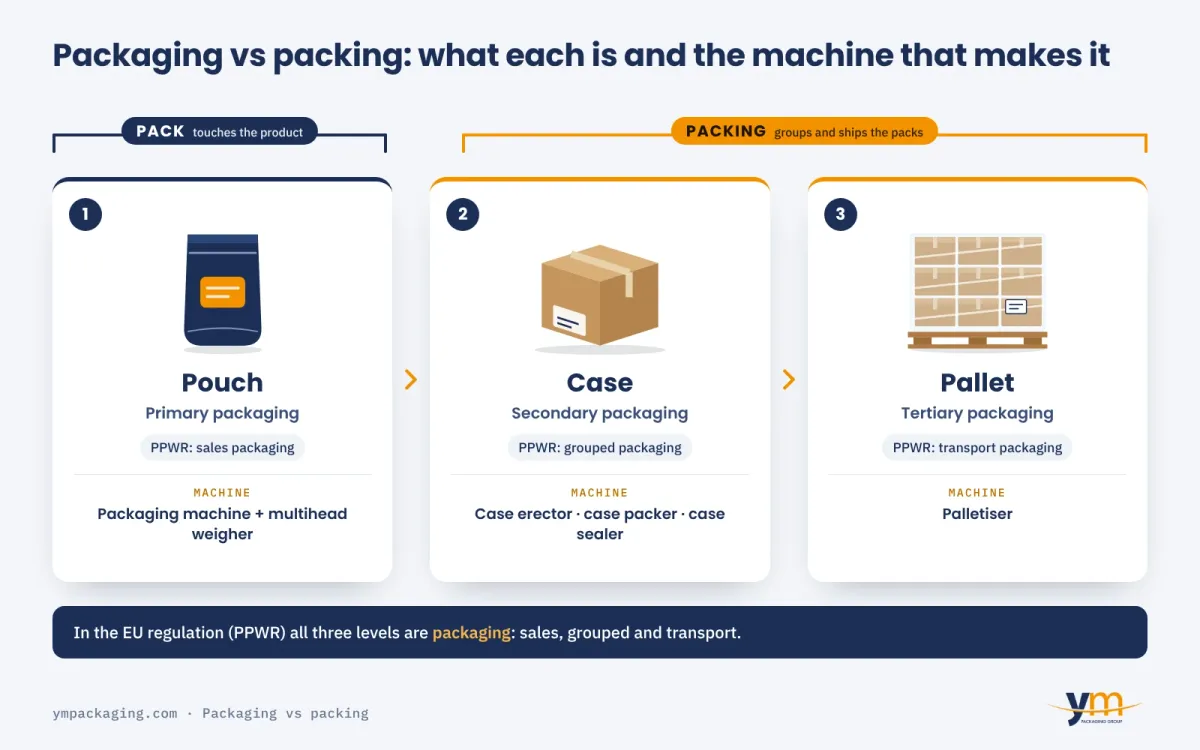
What is a pack (primary packaging)
The primary pack is the container or wrapper in contact with the product: it holds it, protects it and carries the information for the consumer.
EU law defines packaging very broadly. Regulation (EU) 2025/40 on packaging and packaging waste (PPWR) treats as packaging the items of any material used to contain, protect, handle, deliver or present products. Within that, the pack that reaches the consumer is the sales packaging.
In the food industry, when people talk about the pack they mean the unit that reaches the shopper:
- The bag of crisps or nuts.
- The spice jar.
- The meat tray with its film.
- The bottle of oil or sauce.
- The sugar sachet.
The pack is what the consumer buys, takes home and opens. That is why it is called the sales unit: it keeps the product safe from air, moisture or light, and it carries the brand, the ingredients, the weight and the date.
What is packing (transport packaging)
Packing is what groups, protects and moves the packs: the case that holds several bags, the shrink film around a multipack, or the pallet with its stretch film and logistics label.
If the pack is designed for the consumer, packing is designed for logistics. Its job is to protect the goods from knocks, moisture and crushing in storage and transport, to let the load be stacked safely, and to identify it so the warehouse and the haulier know what they are moving.
Examples of packing in the food industry:
- The corrugated cardboard case that holds bags or jars.
- The cardboard tray with shrink film that groups bottles or cans.
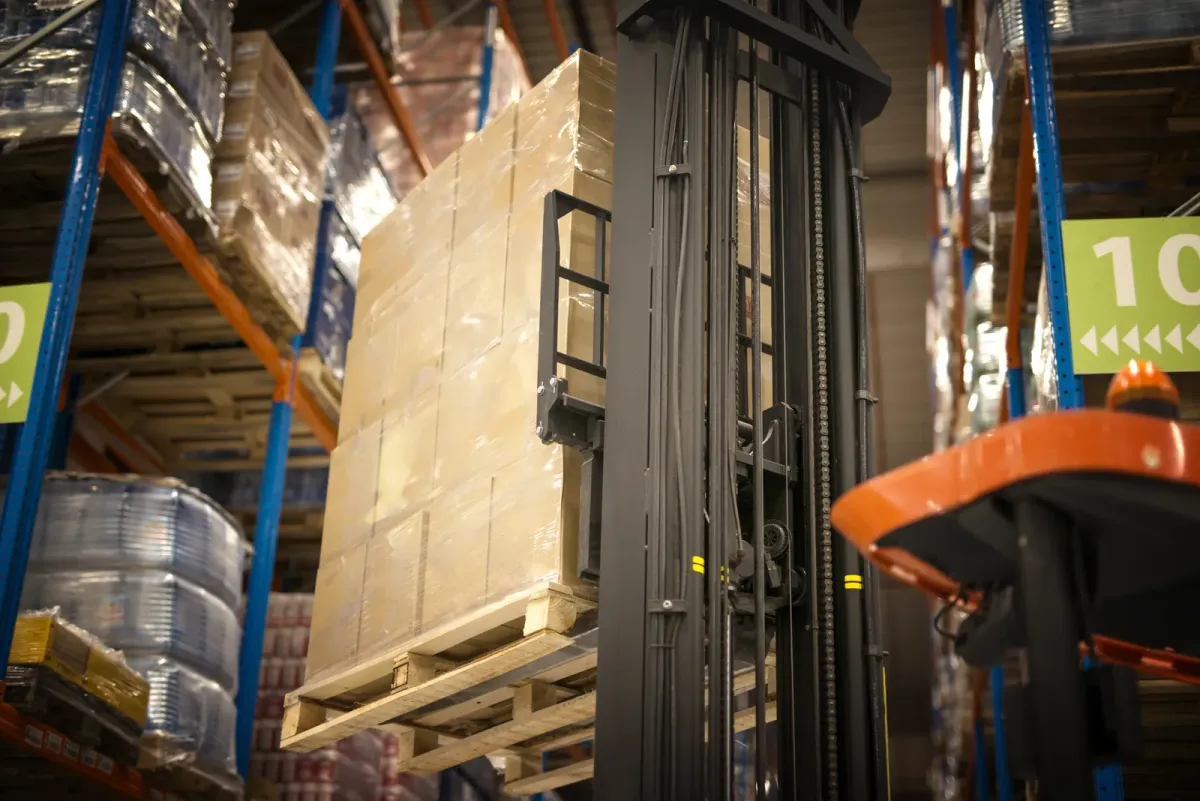
- The pallet of stacked cases, stabilised with stretch film and labelled.
In everyday English, packaging is the umbrella word for both levels, and packing is closer to the logistics side. You will see both on machine catalogues: a "packaging machine" makes the pack, and "packing" or "end-of-line" equipment builds the case and the pallet. Spanish draws the same line with two different words, envase and embalaje.
Packaging vs packing: comparison table
The primary pack touches the product and speaks to the consumer; packing groups packs and is designed for the warehouse and for transport. This table sums up the difference point by point.
| Primary pack | Packing (secondary and transport) | |
|---|---|---|
| Contact with the product | Yes, direct | No: it holds packs |
| Main function | Hold, preserve and protect the product, and inform the consumer | Group and protect packs, and make handling and transport easier |
| Who sees it | The consumer, in the shop and at home | The warehouse, the haulier and the point of sale |
| Level | Primary packaging | Secondary and tertiary packaging |
| Name in the EU regulation | Sales packaging | Grouped packaging (secondary) and transport packaging (tertiary) |
| Example (nuts) | 200 g bag | Cardboard case of bags; pallet of cases |
| Common materials | Flexible film, heat-sealable paper, jar, tray, glass | Corrugated cardboard, shrink or stretch film, wooden or plastic pallet |
| Machine that makes it | Packaging machine (vertical, horizontal, flow wrap) and its doser | Case packer, case erector and case sealer, palletiser |
For the three levels in more detail, see our guide to primary, secondary and tertiary packaging.
Pack, case and labelling
Each level carries its own information. The pack carries the consumer information: the name of the food, the ingredients, the weight, the best-before date and the lot. The case and the pallet carry the logistics information: the product code, the number of units inside, the lot and, on the pallet, the unit-load label. That is why the lot and the date must match on both levels: it is the basis of traceability.
Package, packaging and packing: are they the same?
Not exactly. The package is the finished unit: the product in its pack. Packaging is the material and the system that protect it, at every level, and also the industry that designs and makes it. Packing usually means preparing goods for storage and shipment: putting packs into cases and cases onto pallets.
Usage varies between countries and companies, and many texts use packaging and packing as synonyms. So when you read about the difference, check how each word is used in that text. In practice, what matters is telling apart what touches the product (the pack) from what is used to move it (the packing).
What the rules say: sales, grouped and transport packaging
The EU regulation does not split the levels into packaging and packing: Regulation (EU) 2025/40 (PPWR) calls all three levels packaging, and says that sales packaging, grouped packaging and transport packaging should be defined separately.
Recital 10 of the regulation adds that sales packaging corresponds to primary packaging, grouped packaging to secondary packaging and transport packaging to tertiary packaging (EUR-Lex, OJ L of 22.1.2025). These are the terms you will find in suppliers' declarations and in compliance documents. More detail in our PPWR guide.
In Spain, additionally, Royal Decree 1055/2022 on packaging and packaging waste (BOE-A-2022-22690, published on 28/12/2022) uses the same three levels (envase de venta, colectivo and de transporte) and does not define the everyday word for packing, embalaje. It also classifies packaging by who uses it: household, commercial and industrial packaging.
General information, not legal advice. Check the official text in force.
Examples of packaging and packing in food
Almost every packed food has three layers: the pack you buy, the case that groups several of them and the pallet that reaches the warehouse. Here are some examples (the number of units per case is only an illustration):
- Nuts: pillow bag of film → cardboard case of, for example, 10 to 30 bags → pallet.
- Coffee: bag with a valve, or capsules → display case → pallet.
- Pulses and rice: 500 g or 1 kg bag → case or film-wrapped tray → pallet.
- Flour and sugar: paper bag → case or bundle → pallet.
- Frozen food: PE bag → cardboard case → pallet.
In each row, the first item is the primary pack and the rest is the packing. The product changes, but the logic is the same.
Which machine makes the pack and which makes the packing
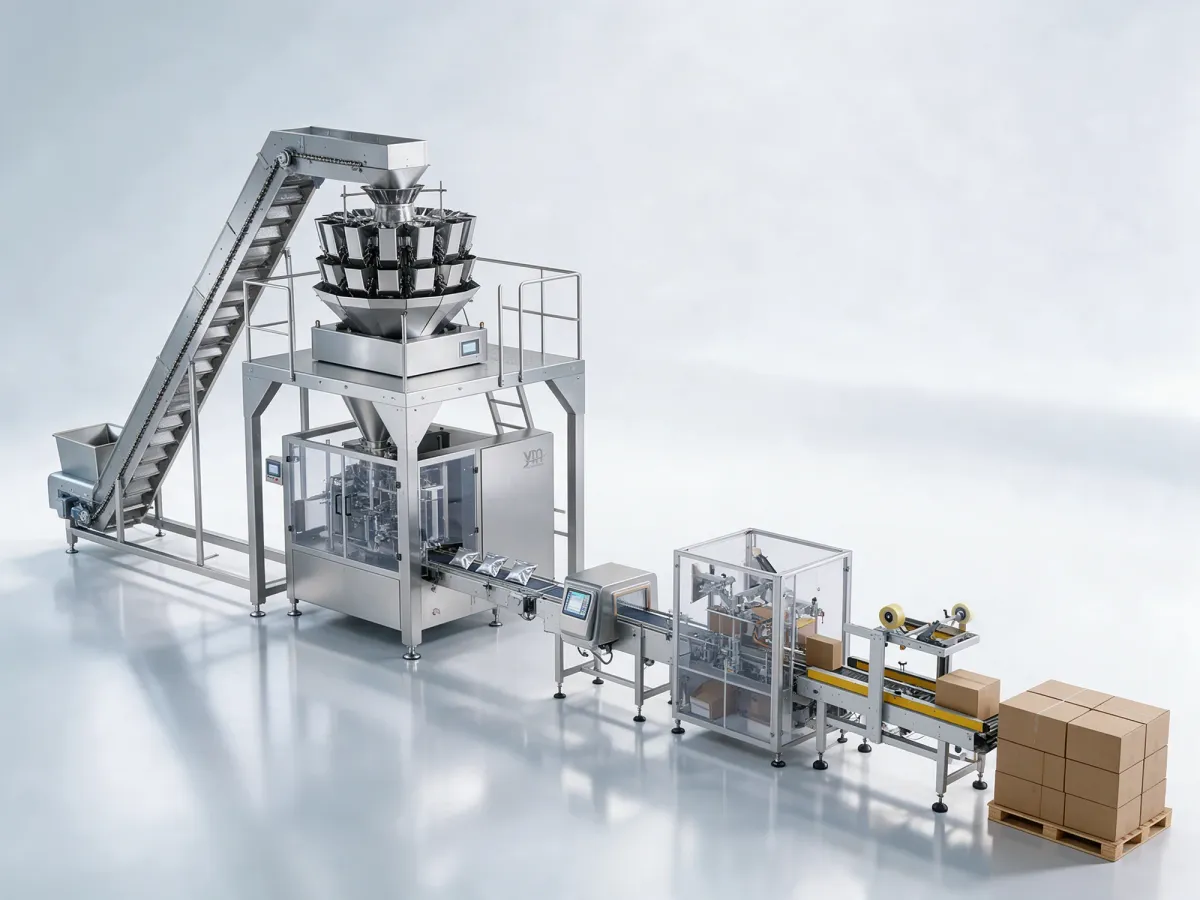
The pack is formed and filled by the packaging machine and its doser; the packing is built by the end-of-line machines: case packing, case sealing and palletising.
At YM Packaging Group, a Spanish manufacturer of packaging machinery and turnkey lines, we design both the pack side (packaging machines and weighers) and the packing side (case packing and palletising).
Machines for the pack (primary packaging)
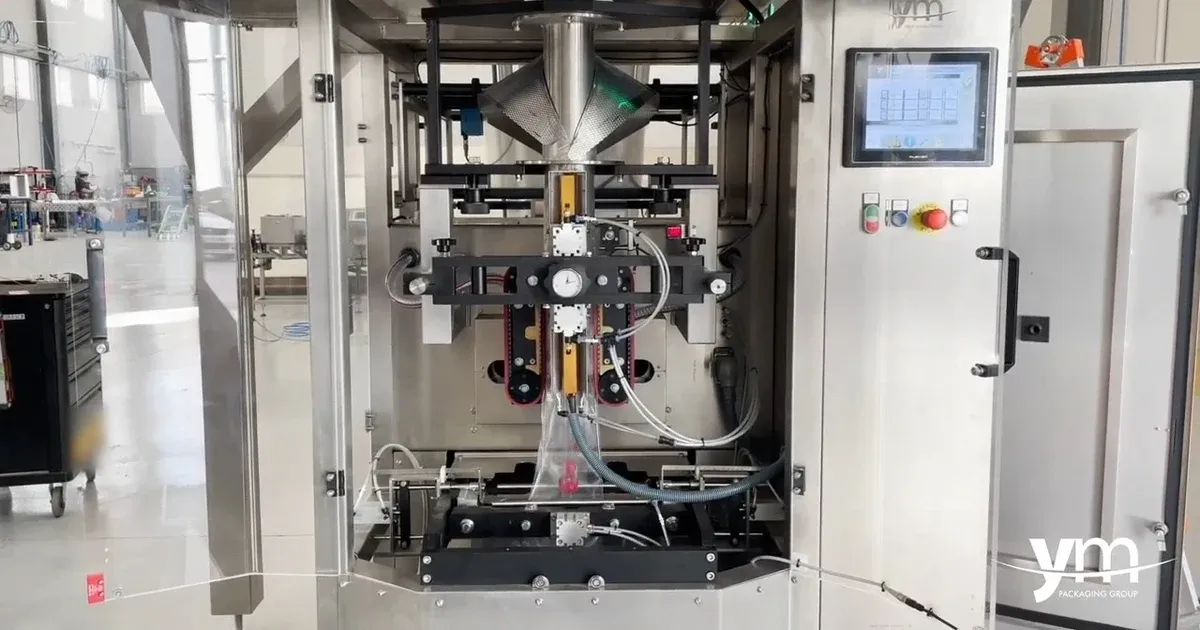
This is primary packaging. Vertical packaging machines, horizontal machines and flow wrappers form or receive the bag, fill it and seal it; fillers do the same with jars and bottles. Above the packaging machine sits the doser each product needs: a multihead weigher for snacks and nuts, an auger for powders or a pump for liquids.
Machines for the packing (secondary packaging and end of line)
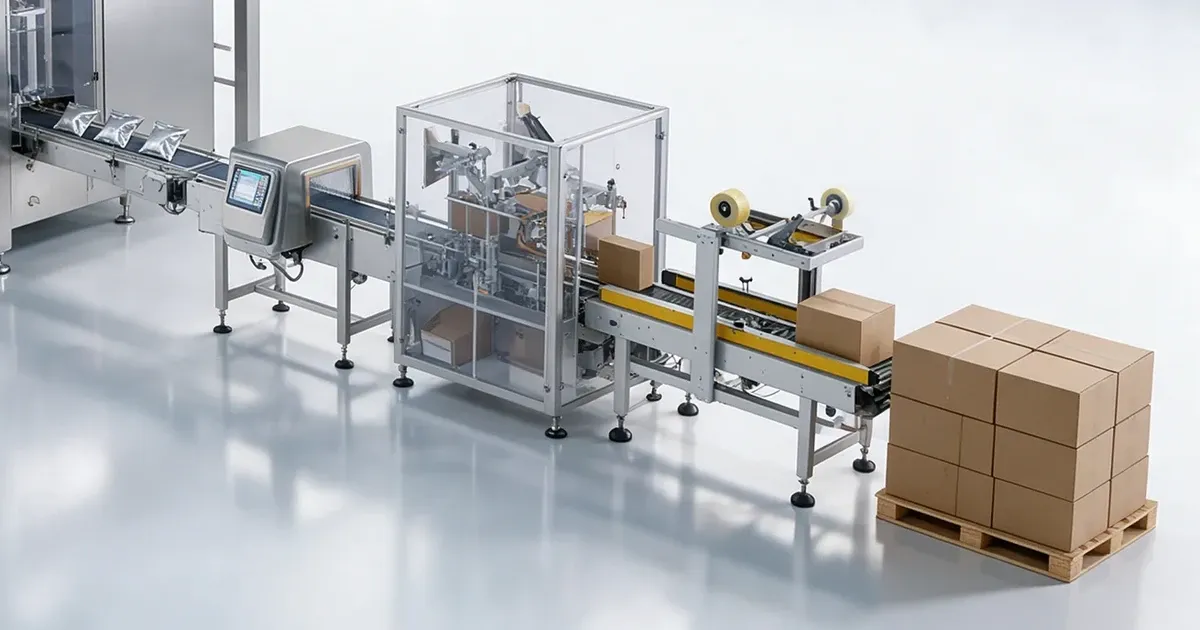
This is secondary packaging. A case erector forms the cardboard case, a bag inserter or a case packer places the packs inside, and a case sealer closes it. Then automatic palletisers stack the cases on the pallet: cartesian palletisers, anthropomorphic robots or collaborative robots. All this packing machinery works at the pace of the packaging machine.
In between: quality control
Before the bag goes into the case, it should be checked: a metal detector rejects packs with metal contamination and a checkweigher rejects the ones below the declared weight. This is the quality control that sits between the pack and the packing.
Example: a nut line, from pack to pallet. A nut producer packs 200 g bags. Pack: a multihead weigher doses each bag and a vertical packaging machine forms, fills and seals it from the reel of film. Before case packing, a metal detector and a checkweigher check every bag. Secondary packaging: the F2 case erector forms the case (up to 12 cases/min according to its datasheet), the bags go into the case (for example, 20 per case) and the automatic case sealer closes it with 48 mm tape. Tertiary packaging: a cartesian palletiser (up to 10 cycles/min) stacks the cases on a Euro pallet of 1200 × 800 mm, which is then stabilised with film and labelled for transport.
If you want the whole line, from doser to pallet, see our complete packaging lines.
How to reduce packaging and packing
You can cut material on both levels: packs with less film or mono-material film, and packing without empty space, with right-sized cases and well-planned pallet patterns.
- Lighter packs: thinner or recyclable mono-material films. We explain it in our guide to sustainable packaging.
- Cases sized to the contents: less air inside the case means less cardboard and more cases per pallet.
- A well-planned pallet pattern: a layer pattern designed around the case size makes better use of the pallet base and of the truck.
- EU rules: the packaging regulation asks for packaging to be minimised and for empty space to be limited; we sum it up in our PPWR guide.
On the machine side, changing the bag size or the case format is a format change on the packaging machine and on the case erector: plan it with the manufacturer.
Do you have a packaging project?
Want to automate everything from the pack to the pallet? Tell us about your product and we will propose the complete line. Request information.
Frequently asked questions
What is the difference between packaging and packing?
Primary packaging is in direct contact with the product: it holds it, protects it and carries the information for the consumer. Packing (secondary and transport packaging) groups and protects several packs so they can be stored, handled and shipped, like a cardboard case or a pallet.
Are packaging and packing the same thing?
Not quite. The words are often used loosely, but the pack is the unit the consumer buys, and packing is what groups those units for logistics. In EU law all three levels are called packaging: sales, grouped and transport packaging.
What are primary, secondary and tertiary packaging?
Primary packaging is the sales pack, in contact with the product. Secondary packaging groups several sales units, like a case or a multipack. Tertiary packaging makes it easier to transport those groups, usually on a pallet. The EU packaging regulation calls them sales, grouped and transport packaging.
What is the difference between package, packaging and packing?
The package is the finished unit (the product in its pack). Packaging is the material and the system that protect it, at every level. Packing usually means preparing goods for storage and shipment: putting packs into cases and cases onto pallets.
What are some examples of packaging and packing?
A bag of nuts is the primary pack; the cardboard case holding twenty bags and the pallet carrying those cases are the packing. The same goes for a spice jar, its film-wrapped tray and the pallet.
Which machines make the pack and the packing?
The pack is made by packaging machines (vertical, horizontal or flow wrap) with their doser, such as a multihead weigher. The packing is made by end-of-line machines: case erectors, case packers, case sealers and palletisers.